
What Does the West Asia Crisis Mean for India’s Economy?
Posted On Tuesday, Mar 24, 2026

Over the past few years, geopolitics has steadily returned to the center of global economic discussions. If 2025 was largely defined by tariffs, supply chain shifts and trade fragmentation, the early months of 2026 are increasingly being shaped by geopolitical tensions.
This time, the focus has shifted to West Asia, where escalating conflict and disruptions around the Strait of Hormuz have injected fresh uncertainty into global energy markets.
Few waterways matter as much to global energy trade as the Strait of Hormuz. Roughly 20–30% of global oil and gas shipments pass through this narrow channel1, linking the Persian Gulf to global markets. Any disruption here reverberates quickly across energy prices, freight costs and supply chains.
Recent tensions involving Iran and regional actors have already begun to affect tanker movements and shipping insurance costs. Even when production remains intact, logistical disruptions are likely to drive volatility in energy markets.
For energy-importing economies like India, these developments are not merely geopolitical headlines. They quickly translate into macroeconomic variables.
To understand the implications of the current situation, it is useful to look back at the most recent global energy shock: the Russia–Ukraine War.
1Source: Economic Times
Lessons from the Russia–Ukraine Energy Shock
When Russia invaded Ukraine in early 2022, global energy markets reacted almost instantly. Oil prices surged above $100 per barrel for several months2, fuelling inflation across major economies and forcing governments to step in to cushion households and businesses.
India too felt the impact through multiple channels.
Crude prices rose sharply, with the Indian crude basket averaging around $95 per barrel in FY23, compared with roughly $80 the year before2. Retail fuel prices increased modestly, although government tax cuts helped moderate the pass-through to consumers.
The bigger fiscal impact came through higher subsidies, particularly for fertilizers as natural gas prices surged globally. Major subsidies rose significantly, while inflation averaged around 6.6% in FY23 and the fiscal deficit widened to about 6.5% of GDP3.
To manage the shock, the government deployed several policy measures. Excise duties on petrol and diesel were cut, fertilizer subsidies were increased sharply and targeted support was extended to LPG consumers. Oil marketing companies also absorbed part of the price increase through lower margins.
The result was a visible but manageable macroeconomic shock.
In many ways, the Russia-Ukraine conflict became a template for how global energy shocks transmit through the Indian economy.
However, the current West Asia crisis differs in several important ways.
2Source: Bloomberg
3Source: Controller General of Accounts of India (CGA)
How the Current Crisis is Different
1) A Logistics Shock, Not Just a Supply Shock
The Russia-Ukraine conflict was fundamentally a supply shock.
Russia plays an outsized role in global commodity markets, accounting for roughly 10% of global crude exports, nearly 20% of pipeline natural gas trade and around 15–20% of fertilizer exports4. Disruptions to these supplies triggered ripple effects across energy, agriculture and industrial markets.
The situation in West Asia today is slightly different.
Production across Gulf countries has largely remained intact. The risk lies instead in transportation through the Strait of Hormuz, which serves as the main maritime gateway for energy exports from the region.
Nearly 30% of global seaborne oil trade and about 20% of LNG shipments pass through this corridor4.
In other words, the current crisis is less about whether energy is produced and more about whether it can move safely across global shipping lanes.
2) Uncertainty Around Duration
The Russia-Ukraine war evolved into a prolonged geopolitical conflict that reshaped global energy trade for years.
The duration of the West Asia tensions too remains nonetheless uncertain.
Some signals suggest the disruption may persist. Asian countries have already begun competing aggressively for LNG and LPG cargoes5, pushing up prices. At the same time, the structure of oil futures markets indicates that traders still view the spike as temporary, even if prices remain elevated in the near term6.
Based on the various media reports, the conflict so far has also involved limited damage to energy infrastructure, and global diplomatic pressure to stabilize shipping routes remains high.
For now, markets appear to be pricing in temporary disruption rather than a prolonged energy crisis, though the risk of escalation cannot be ruled out.
3) India’s Energy Position Is Stronger Today
Another important difference lies in India’s own energy positioning.
Since 2022, India has significantly diversified its crude import sources. Following Western sanctions on Russia, India increased purchases of discounted Russian crude, reducing its dependence on Middle Eastern supply routes7.
Today, a larger share of India’s oil imports comes from Russia, the United States, Brazil and West Africa7, which reduces direct exposure to disruptions in the Strait of Hormuz to some extent.
India also maintains strategic petroleum reserves and commercial inventories that can cover several weeks of consumption, providing an important short-term buffer.
However, dependence on Gulf supplies remains significant for LNG and LPG, which means disruptions in gas markets could still affect parts of the economy.
4Source: Bloomberg
5Source: Bloomberg
6Source: Bloomberg
7Source: CMIE
How the Shock Could Affect India
As seen historically - energy shocks affect India through four key macroeconomic channels: Inflation, Growth, Fiscal balances and the Current Account.
1) Inflation
Energy prices influence inflation both directly and indirectly.
In India’s Consumer Price Index (CPI) basket - Liquid fuels and gas carry a weight of roughly 6.8%8, meaning changes in fuel prices do have a direct influence on headline inflation.
If crude oil prices rise from our base assumption of $70 per barrel to around $90, we believe retail fuel prices may increase modestly depending on how the burden is shared between oil companies, government tax adjustments and consumers.
Such a scenario could push headline inflation higher by ~ 50 - 60 basis points, even before accounting for second-round effects.
Indirect effects come through higher transportation, logistics and aviation costs, thus eventually affecting services such as taxis, freight and restaurants. Taken together, the overall inflation impact could approach ~ 70 - 80 basis points, pushing inflation toward 4.7% in FY27.
While still manageable, this would reduce the policy comfort margin for the Reserve Bank of India.
8Source: Ministry of Statistics and Program Implementation (MoSPI)
How the Shock Could Affect India
2) Growth
Higher energy prices also affect economic growth through rising production costs.
Energy accounts for roughly ~2 - 4% of operating expenditure for listed companies9, and higher fuel prices increase transportation and logistics costs across sectors. According to sensitivity analysis by the Reserve Bank of India, a 10% increase in crude oil prices could reduce India’s GDP growth by around 15 basis points10.
Supply chain disruptions could amplify this effect. The Strait of Hormuz is not only critical for crude oil but also for LNG, LPG, fertilizers, sulphur and petrochemicals. Any sustained disruption could affect sectors such as fertilizers, chemicals, agriculture and manufacturing.
Under a baseline assumption of $70 oil, India’s growth outlook for FY27 remains around 7.5%. If crude prices average closer to $90 per barrel and supply disruptions persist, growth could moderate toward 6.5–6.8% much below 7%.
8Source: Mint
10Source: Reserve bank of India (RBI)
How the Shock Could Affect India
3) Fiscal Impact
Energy shocks also tend to spill over into public finances.
During the Russia-Ukraine crisis, the government relied on excise duty cuts and higher subsidies to protect consumers. A similar response could occur again.
Higher global fertilizer prices could increase subsidy requirements, while lower margins for oil marketing companies (OMCs) may reduce dividends from public sector energy firms.
In addition, potential excise duty reductions could lower tax revenues.
Taken together, these pressures could widen the fiscal deficit by around 0.4–0.6% of GDP, depending on how long oil prices remain elevated.
4) Current Account
The external sector is often the first place where energy shocks show up.
India imports nearly 90% of its crude oil requirements11, meaning higher oil prices directly increase the import bill. The Gulf region also remains a key trade partner, accounting for a meaningful share of India’s exports and imports.
Under our base case scenario, where crude oil prices average around $70 per barrel, India’s current account deficit (CAD) is expected to remain relatively contained at around 1.5% of GDP.
However, the situation could shift if crude prices remain elevated for an extended period. If oil prices were to average closer to $90 per barrel, higher energy costs would directly increase the value of imports, while some export segments particularly those linked to global demand or energy-intensive production could face margin pressures.
Under such a scenario, the CAD could widen to around 2.3% of GDP. While this level would still remain within a broadly manageable range for India, it would make the external balance more sensitive to global capital flows and investor sentiment.
In periods of heightened geopolitical uncertainty or tighter global financial conditions, a wider CAD shifts the dependance on stable capital inflows such as foreign direct investment and portfolio flows to maintain balance in the external account.
11Source: CMIE
Implications for Debt Markets
Historically, geopolitical shocks have rarely stayed confined to commodity markets. They quickly spill over into financial markets, particularly government bonds.
Indian bond markets have already begun reflecting this uncertainty.
Short-term yields have moved higher as investors price in the inflation risks associated with rising crude prices. Meanwhile, the longer end of the curve has been influenced both by domestic inflation expectations and global bond market sentiment.
Chart I: G-Sec yield curve moved up, belly of the curve relatively unchanged due to RBI intervention
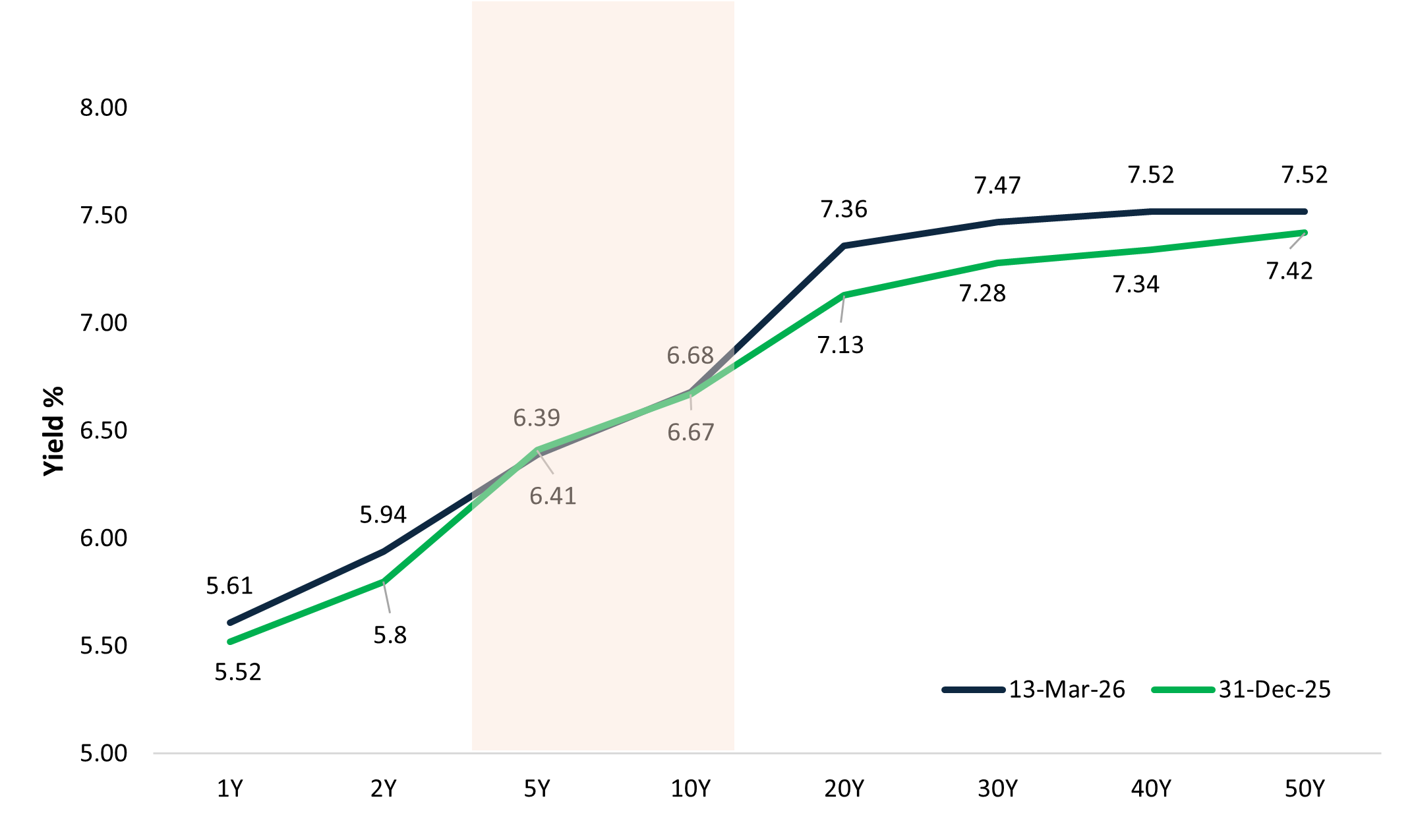
Data Source: Bloomberg. Quantum AMC Graphics. Data on December 31, 2025 and March 13, 2026
Recent trading sessions have seen the 10-year government bond yield move toward the 6.70% - 6.75% range, reflecting concerns around oil prices and inflation. At the same time, active bond purchases by the Reserve Bank of India have helped anchor yields and prevent excessive volatility.
As a result, the yield curve has displayed a familiar pattern during geopolitical shocks: the front end has sold off sharply, the belly of the curve remains volatile but supported, and the long end reflects both domestic macro risks and global yield movements.
For investors, this environment reinforces the importance of flexibility.
Periods of geopolitical uncertainty tend to produce rapid shifts in bond market expectations. Rather than taking rigid duration positions, investors may benefit from strategies that can actively adjust exposure as market conditions evolve.
Dynamic bond funds, which allow portfolio managers to shift between short- and long-duration securities depending on interest-rate trends, can be particularly well suited to such phases of market volatility.
A Moment for Perspective
Geopolitical crises often create sharp short-term market reactions. Yet history suggests that their macroeconomic impact depends largely on how long they persist.
For India, the current West Asia tensions certainly introduce risks, particularly through higher energy prices. However, the economy today is better positioned than in previous cycles, supported by diversified energy imports, stronger foreign exchange buffers and more resilient domestic demand.
The situation remains fluid, and markets will continue reacting to every new development.
But for investors and policymakers alike, the key challenge is not merely reacting to volatility, it is distinguishing temporary disruptions from lasting structural shifts.
And for now, the evidence suggests that while the road ahead may be volatile, the underlying macroeconomic foundations remain intact.
For any queries directly linked to the insights and data shared in the newsletter, please reach out to the author - Sneha Pandey, Fund Manager - Fixed Income at [email protected].
For all other queries, please contact Mohit Bhatnagar - Head - Sales, Quantum AMC at [email protected] / [email protected] or call him on Tel: 9987524548
Read our last few Debt Market Observer write-ups -
- Looking Beyond the 10-Year Benchmark: Decoding India’s Bond Market Signals
- From Fiscal Math to Market Outcomes: What Changes for Bonds as FY26 Ends
Disclaimer, Statutory Details & Risk Factors:The views expressed here in this article / video are for general information and reading purpose only and do not constitute any guidelines and recommendations on any course of action to be followed by the reader. Quantum AMC / Quantum Mutual Fund is not guaranteeing / offering / communicating any indicative yield on investments made in the scheme(s). The views are not meant to serve as a professional guide / investment advice / intended to be an offer or solicitation for the purchase or sale of any financial product or instrument or mutual fund units for the reader. The article has been prepared on the basis of publicly available information, internally developed data and other sources believed to be reliable. Whilst no action has been solicited based upon the information provided herein, due care has been taken to ensure that the facts are accurate and views given are fair and reasonable as on date. Readers of this article should rely on information/data arising out of their own investigations and advised to seek independent professional advice and arrive at an informed decision before making any investments. Mutual Fund investments are subject to market risks, read all scheme related documents carefully. |

View All
Related Posts
-

The Case for the December Pivot
Posted On Monday, Sep 21, 2026
For the last twelve months, Indian fixed income has been a story of comfortable pauses, benign carry, and a gently steepening curve.
Read More -

What Does the West Asia Crisis Mean for India’s Economy?
Posted On Tuesday, Mar 24, 2026
Over the past few years, geopolitics has steadily returned to the center of global economic discussions.
Read More -

Looking Beyond the 10-Year Benchmark: Decoding India’s Bond Market Signals
Posted On Thursday, Feb 26, 2026
If you glance at India’s financial headlines today, the tone feels reassuring.
Read More