
India’s Macro Backdrop: Past Fragility, Present Strength
Posted On Friday, Apr 24, 2026

There are moments in markets when déjà vu strikes - may be not so perfectly, but close enough to stir memory. For seasoned investors, the 2011 - 2013 period brings back memories of a time when India was counted among the “Fragile Five” - a label that underscored worries about its external vulnerabilities, a volatile currency, and heavy reliance on global capital flows.
That phase did not begin in India, it began with a signal… a shift in U.S. monetary policy that triggered what we now remember as the “taper tantrum”. When the U.S. Federal Reserve hinted at reducing its easy-money policies in 2013, global liquidity tightened almost overnight. Capital that had been flowing freely into emerging markets reversed course. And economies with underlying imbalances were suddenly in the spotlight.
And India was one of them. India, with a widening current account deficit and elevated inflation, found itself at the center of that storm.
Recent tensions involving Iran and regional actors have already begun to affect tanker movements and shipping insurance costs. Even when production remains intact, logistical disruptions are likely to drive volatility in energy markets.
To fully understand why the 2011–2013 period left such a deep mark, it helps to revisit what led up to it.
In the years following the 2008 Global Financial Crisis, the world’s major central banks (led by the Federal Reserve) flooded the financial system with liquidity. Interest rates in developed markets were pushed to near zero, and large-scale asset purchases injected trillions of dollars into global markets.
This led investors to consider seeking higher yields elsewhere.
Emerging markets, including India, became key beneficiaries of this wave of capital. Foreign investors poured money into equities and debt, currencies strengthened, and financing deficits became easier.
For a period, this inflow masked underlying imbalances. India, in particular, was running a sizable current account deficit (~ 4.2% in FY 12 and ~ 4.7% in FY 13) 1driven largely by high imports of oil and gold while inflation remained persistently elevated.
The turning point came in 2013…
In May of that year, Ben Bernanke signaled that the Federal Reserve might begin to “taper,” (gradually reduce), its bond-buying program. It was a subtle shift in language but markets interpreted it as the beginning of the end of easy money era.
The reaction was swift and global.
Investors began pulling capital out of emerging markets and reallocating it back to the United States in anticipation of higher returns there. This sudden reversal of flows is what we now refer to as the Taper Tantrum. Countries that had relied heavily on foreign capital to finance their deficits were hit the hardest and India was among the most exposed.
1Source: Bloomberg
The mechanics of the stress were straightforward, but the speed was unsettling.
As capital flowed out, demand for the rupee weakened sharply. The currency began to depreciate and not gradually, but in steep, confidence-shaking moves. Within months, the rupee had lost nearly a fifth of its value, becoming one of the worst performing currencies globally at the time. For an import-dependent economy, this had immediate consequences: oil became expensive, inflation risks intensified, and macro stability came under question.
Chart I: During 2011–2014, the Indian rupee weakened, but less than most emerging market peers, signaling relative resilience.
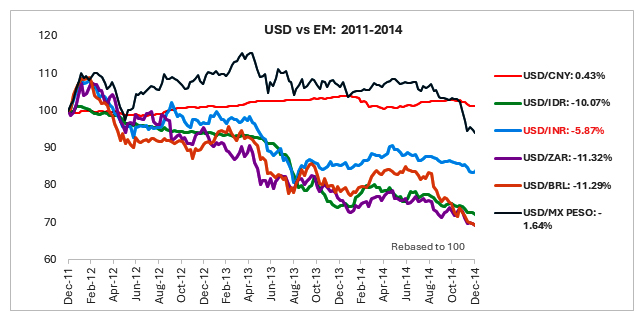
Data Source: Refinitiv DataStream. Quantum Graphics. Data from Dec 31, 2011 to December 31, 2014
INR: Indian Rupee, IDR: Indonesian Rupiah, CNY: Chinese Yuan, BRL: Brazilian Real, ZAR: South African Rand, MX PESO: Mexican Peso
At the same time, the bond market began to reprice aggressively.
Foreign institutional investors, who had been significant buyers of Indian debt, started selling. This pushed bond prices down and yields sharply higher. Government borrowing costs rose, liquidity tightened, and financial conditions became restrictive across the system. What had begun as an external shock was now feeding directly into domestic markets.
Policymakers found themselves cornered, compelled to act swiftly with little margin for error. Inflation was elevated, hovering close to 10% YoY, and the Reserve Bank responded by tightening monetary policy - raising the repo rate from 6.75% in April 2011 to 8.5% by March 2012 2.
Chart II: Rising stress pushed 10-year Government bond yields from ~7.4% to ~9% during the taper period.
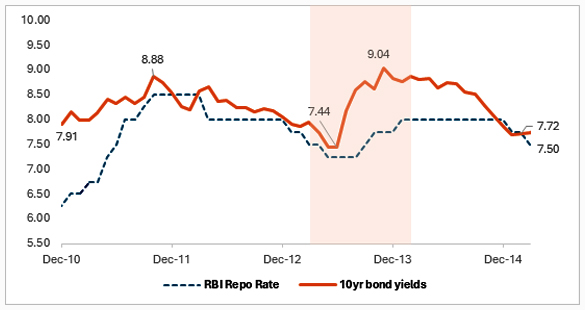
Data Source: Bloomberg. Quantum AMC Graphics. Data for the period December 31, 2010, to December 31, 2014
While the central bank raised short-term interest rates and tightened liquidity to stabilize the currency, measures were also introduced to curb gold imports - one of the key drivers of the current account deficit. Various steps were taken to attract foreign capital back into the system. These actions were necessary, but they also underscored the nature of the response, the system was stabilizing under pressure rather than operating from strength.
What made this period particularly significant was not just the market volatility, but what it revealed.
It exposed how quickly global sentiment could shift, and how deeply interconnected India had become with global capital flows. It highlighted the risks of running large external deficits in an environment where financing conditions could change overnight. And perhaps most importantly, it tested the credibility of macroeconomic management in the eyes of global investors.
2Source: Bloomberg
This was not merely a correction driven by cyclical factors. It was a moment of reassessment.
Investors began to differentiate more sharply between emerging markets, rewarding those with stronger fundamentals and penalizing those with visible imbalances. India, at that time, found itself on the more vulnerable side of that divide.
Understanding this sequence is important, because it provides the lens through which current events are being interpreted.
Now, in 2026, the scenario is different, but the tension feels familiar.
This time, the trigger lies not in monetary policy but in geopolitics. The ongoing conflict in West Asia has pushed oil prices sharply higher, once again highlighting a structural reality: India remains deeply sensitive to energy shocks. History reminds us why these matters.
In 2013, when crude prices pushed past the $100-per-barrel mark, inflation surged to around 10% and the current account deficit widened sharply to nearly 5% of GDP - an unmistakable reminder of how closely India’s macro stability is tied to the cost of energy. Nearly a decade later, the pattern resurfaced, albeit in a more tempered form: during 2022 - 23, as oil once again crossed $100, the current account deficit edged up to roughly 2% of GDP 3, suggesting that while the linkage persists, its intensity has moderated.
Chart III: Oil Shocks Then and Now: Less Intense, Still Intact
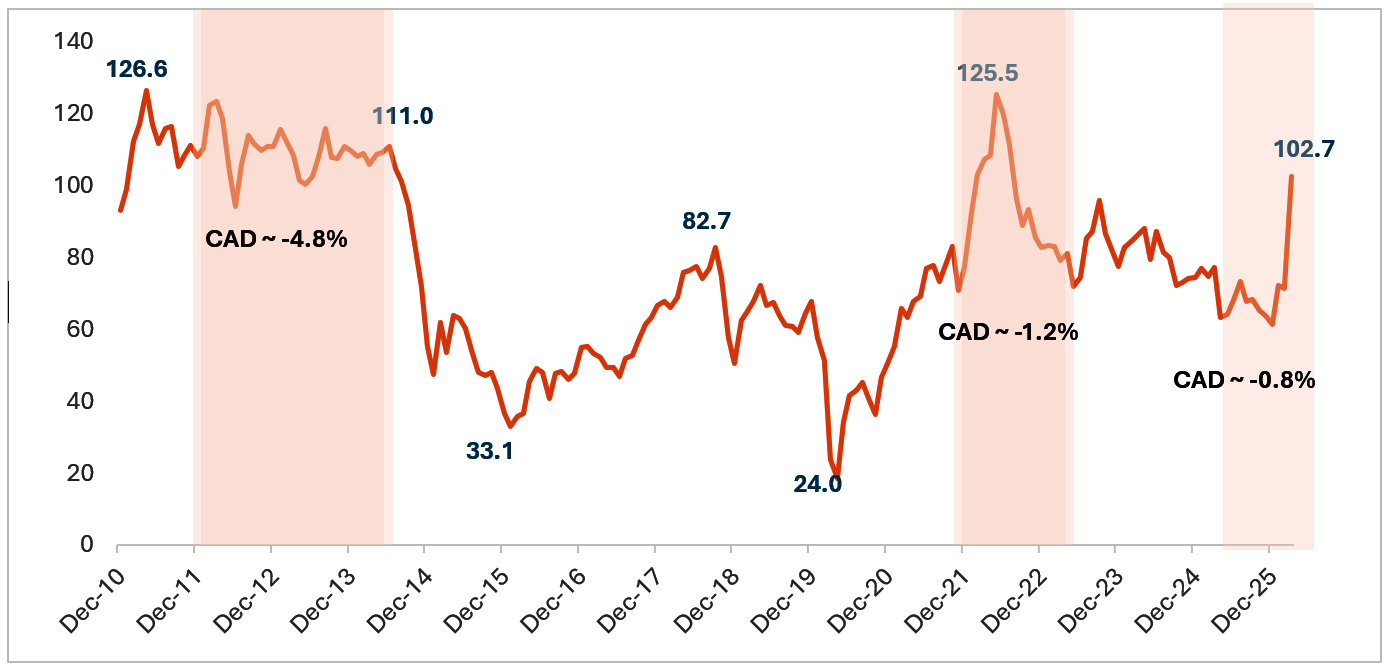
Source: Refinitiv DataStream. Quantum AMC Graphics. Data for the period December 31, 2010 to March 31, 2026
And that is where the comparison begins to sharpen.
3Source: Bloomberg
In both the periods, the vulnerability originates externally. Back then, it was a withdrawal of global liquidity and today, it is a surge in commodity prices combined with geopolitical uncertainty.
In both cases, the transmission channel runs through the same fault lines: current account pressures, currency depreciation, and shifts in investor sentiment.
There is also a deeper structural similarity. Economies that rely on external capital to finance deficits are inherently more exposed during global disruptions. That was the core reason India was labeled “fragile” in 2013 - high inflation, elevated deficits, and dependence on foreign inflows made it particularly sensitive to global shocks.
While the pressures may rhyme, the underlying economy does not. When investors today observe rising oil prices, currency pressures, or shifts in global liquidity, the memory of 2013 inevitably resurfaces. But as the broader data suggests, while the triggers may echo the past, the system responding to them has evolved in meaningful ways.
Over the past decade, India has quietly but materially reshaped its macroeconomic foundations. The crisis of 2013, in many ways, became a catalyst. Policymakers moved toward a credible inflation-targeting regime, fiscal frameworks became more disciplined and transparent, and a series of structural reforms began to address long-standing inefficiencies. None of these changes were in isolation, but taken together, they have meaningfully improved the resilience of the financial system.
This transformation shows up in the data - in stable inflation dynamics, better external buffers, and an anchored policy environment. But perhaps more telling is how it shows up in behavior. Markets today react with greater differentiation and less panic; policymakers respond with better clarity and consistency. In other words, while the headlines may feel familiar, the underlying dynamic has shifted in ways that matter.
Consider the currency. While the rupee today faces pressure (having weakened amid global uncertainty and capital outflows), it is not exhibiting the same disorderly adjustment seen in 2013. The difference lies not in the absence of stress, but in the presence of buffers. Foreign exchange reserves are significantly larger, and the policy response is more calibrated, aimed at reducing volatility rather than reacting to market stress .
Chart IV: While the currency has come under pressure against the U.S. dollar, reserves have continued to build at a strong pace.
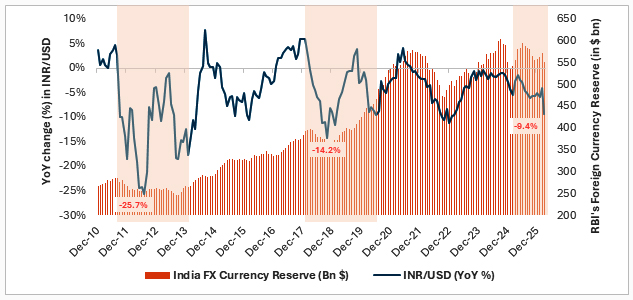
Source: Refinitiv, DataStream. Quantum AMC Graphics. Data for the period December 31, 2010, to March 31, 2026
For YoY change (%) in INR/USD positive value indicate INR appreciation against USD and negative value indicate INR depreciation against USD
Similarly, the bond market reflects an evolution.
In the earlier cycle, yields surged rapidly as foreign investors exited and liquidity tightened. Policy responses, though necessary, added to the sense of urgency. Today, the adjustment appears more measured. Yields are likely to rise as oil-driven inflation feeds through the system, but the expectation is of a gradual repricing rather than a disorderly spike.
Chart V: Between 2011–13 and Today: Crude Prices Rise in Both Cycles, But Bond Yields React Far Less Now
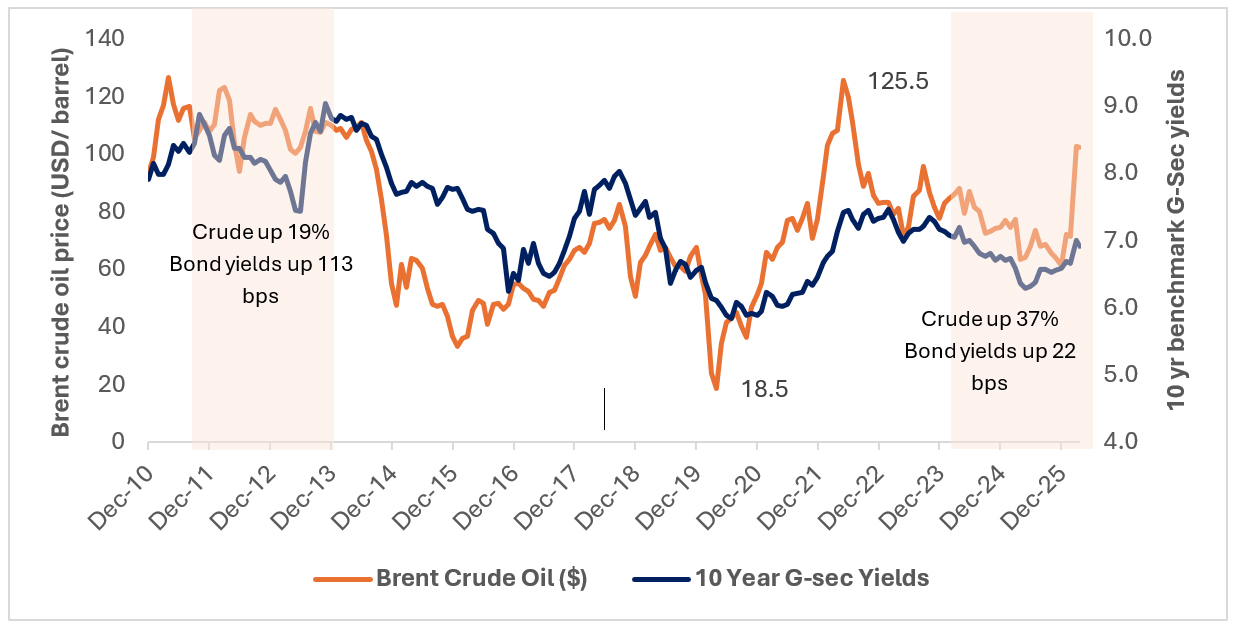
Source: Refinitiv, DataStream. Quantum AMC Graphics. Data for the period December 31, 2010 to April 22, 2026.
This distinction between stress and instability is critical.
It reflects a shift in how India is perceived globally. A decade ago, India was seen as part of a vulnerable cohort. Today, even amid external shocks, it is viewed as a relatively stable growth engine within the emerging market universe.
That does not mean the risks are trivial.
In fact, if anything, the current environment highlights how certain structural sensitivities persist. Oil remains the single most important macro variable for India in the short term. When prices rise sharply, they ripple through inflation, widen the current account deficit, and test policy flexibility.
There is also the question of capital flows. Recent instances of outflows and currency pressure serve as a reminder that global liquidity cycles still matter. But unlike 2013, these movements are not triggering systemic stress - they are being absorbed within a robust macro framework.
This brings us to the central question investors are asking today: Is India “fragile” again?
The more nuanced answer is this: India is exposed, but not fragile.
Exposure is a function of integration. As India becomes deeply embedded in global trade, energy markets, and capital flows, it will inevitably feel the impact of external shocks. Fragility, however, is a function of preparedness. And on that front, the country stands on far stronger footing than it did a decade ago.
The distinction may seem subtle, but it is decisive.
It is the difference between a market that reacts and one that absorbs. Between volatility that destabilizes and volatility that reprices.
For investors, this creates a different kind of opportunity and a different kind of discipline…
The months ahead will likely be shaped by three key factors: the trajectory of oil prices, the stability of remittance and capital flows, and the Reserve Bank’s policy response. Each of these variables has the potential to influence bond yields, currency movements, and broader asset allocation decisions.
But perhaps the important shift is psychological.
In 2013, the narrative was one of fragility under pressure. In 2026, the narrative is nuanced…it is one of resilience being tested. And markets, are likely to trade somewhere between those two ideas.
This is precisely where flexibility begins to matter. In an environment where interest rates and inflation expectations can shift quickly, investment approach that actively adjusts to changing conditions - such as dynamic bond funds - may offer a balanced way to navigate uncertainty. By actively adjusting portfolio duration in response to evolving macroeconomic signals, it seeks to manage interest rate risk and mitigate the possibility of remaining overexposed to any particular phase of the rate cycle.
At the same time, this flexibility works better when risks are not layered unnecessarily. If a portfolio is already taking calls on interest rates, adding credit risk may amplify volatility rather than cushion it. A prudent approach would be to keep credit risk minimal, focusing on high-quality instruments such as AAA-rated PSU bonds and Government securities.
The key point, then, is not about whether history is repeating itself. It is about how differently the same kind of stress is being handled.
For long-term investors, that difference and the ability to adapt alongside it may matter more than the shock itself.
For any queries directly linked to the insights and data shared in the newsletter, please reach out to the author - Sneha Pandey, Fund Manager - Fixed Income at [email protected].
For all other queries, please contact Mohit Bhatnagar - Head - Sales, Quantum AMC at [email protected] / [email protected] or call him on Tel: 9987524548
Read our last few Debt Market Observer write-ups -
- What Does the West Asia Crisis Mean for India’s Economy?
- Looking Beyond the 10-Year Benchmark: Decoding India’s Bond Market Signals
Disclaimer, Statutory Details & Risk Factors:The views expressed here in this article / video are for general information and reading purpose only and do not constitute any guidelines and recommendations on any course of action to be followed by the reader. Quantum AMC / Quantum Mutual Fund is not guaranteeing / offering / communicating any indicative yield on investments made in the scheme(s). The views are not meant to serve as a professional guide / investment advice / intended to be an offer or solicitation for the purchase or sale of any financial product or instrument or mutual fund units for the reader. The article has been prepared on the basis of publicly available information, internally developed data and other sources believed to be reliable. Whilst no action has been solicited based upon the information provided herein, due care has been taken to ensure that the facts are accurate and views given are fair and reasonable as on date. Readers of this article should rely on information/data arising out of their own investigations and advised to seek independent professional advice and arrive at an informed decision before making any investments. Mutual Fund investments are subject to market risks, read all scheme related documents carefully. |

View All
Related Posts
-
The Case for the December Pivot
Posted On Monday, Sep 21, 2026
For the last twelve months, Indian fixed income has been a story of comfortable pauses, benign carry, and a gently steepening curve.
Read More -

What Does the West Asia Crisis Mean for India’s Economy?
Posted On Tuesday, Mar 24, 2026
Over the past few years, geopolitics has steadily returned to the center of global economic discussions.
Read More -

Looking Beyond the 10-Year Benchmark: Decoding India’s Bond Market Signals
Posted On Thursday, Feb 26, 2026
If you glance at India’s financial headlines today, the tone feels reassuring.
Read More