
Can the RBI Continue to Defend the Rupee
Posted On Saturday, May 23, 2026

For much of the past few decades, the rupee’s decline unfolded so gradually that it may not have disturbed investor confidence. A weaker currency became accepted as part of India’s economic story: predictable, controlled and easy to justify.
Chart I: Rupee depreciation more gradual in the past and more rapidly in the near term
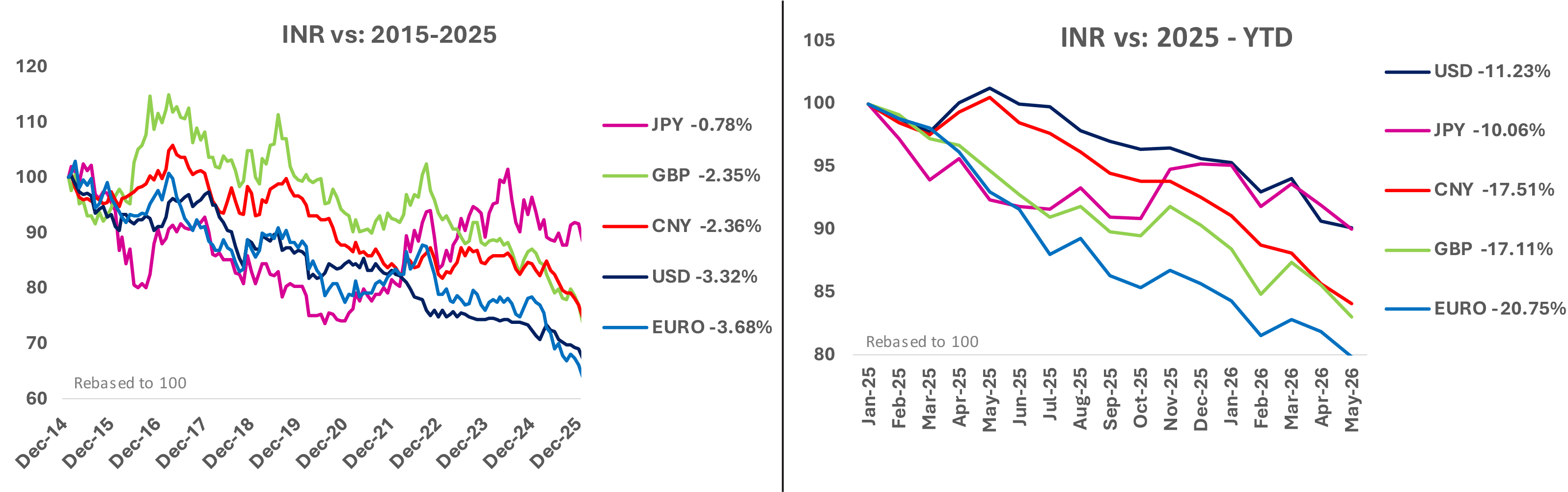
Data Source: Refinitiv DataStream. Quantum AMC Graphics. Data from Jan 01, 2015 to May 19, 2026. Charts rebased to 100 starting Dec 31, 2014 and Dec 31, 2024, respectively. INR: Indian rupee, JPY: Japanese Yen, GBP: Great Britain Pound, CNY: Chinese Yen, USD: United States Dollar, EUR: Euro
But the pressure building currently carries a different undertone. In a matter of weeks, the rupee has breached the 96 per dollar mark for the first time, even as the RBI has reportedly intervened aggressively to contain volatility. Foreign investors have withdrawn over $20 billion from Indian equities and debt markets since March 2026, Brent crude has climbed above $110 a barrel amid escalating tensions in the Middle East, and India’s foreign exchange reserves have declined sharply from their February peak as the central bank spends dollars to defend the currency.
More so, the rupee is no longer weakening only against the US dollar. It has lost ground against a broader basket of major global currencies linked to trade, capital flows and reserve management - an unusual development for an economy still projected to remain among the world’s fastest-growing large nations. Yet policymakers continue to argue that India’s macroeconomic fundamentals remain robust.
That growing divergence between official reassurance and market behavior raises a deeper question: Is the RBI defending the rupee or simply delaying a deeper adjustment?
The immediate triggers for rupee depreciation are easy to identify - Escalating tensions in West Asia, elevated crude oil prices, sustained foreign portfolio outflows, and a stronger US dollar environment. But reducing the rupee’s weakness to a temporary geopolitical shock misses the deeper story unfolding underneath.
Chart II: INR worst hit among global peers on a YTD basis
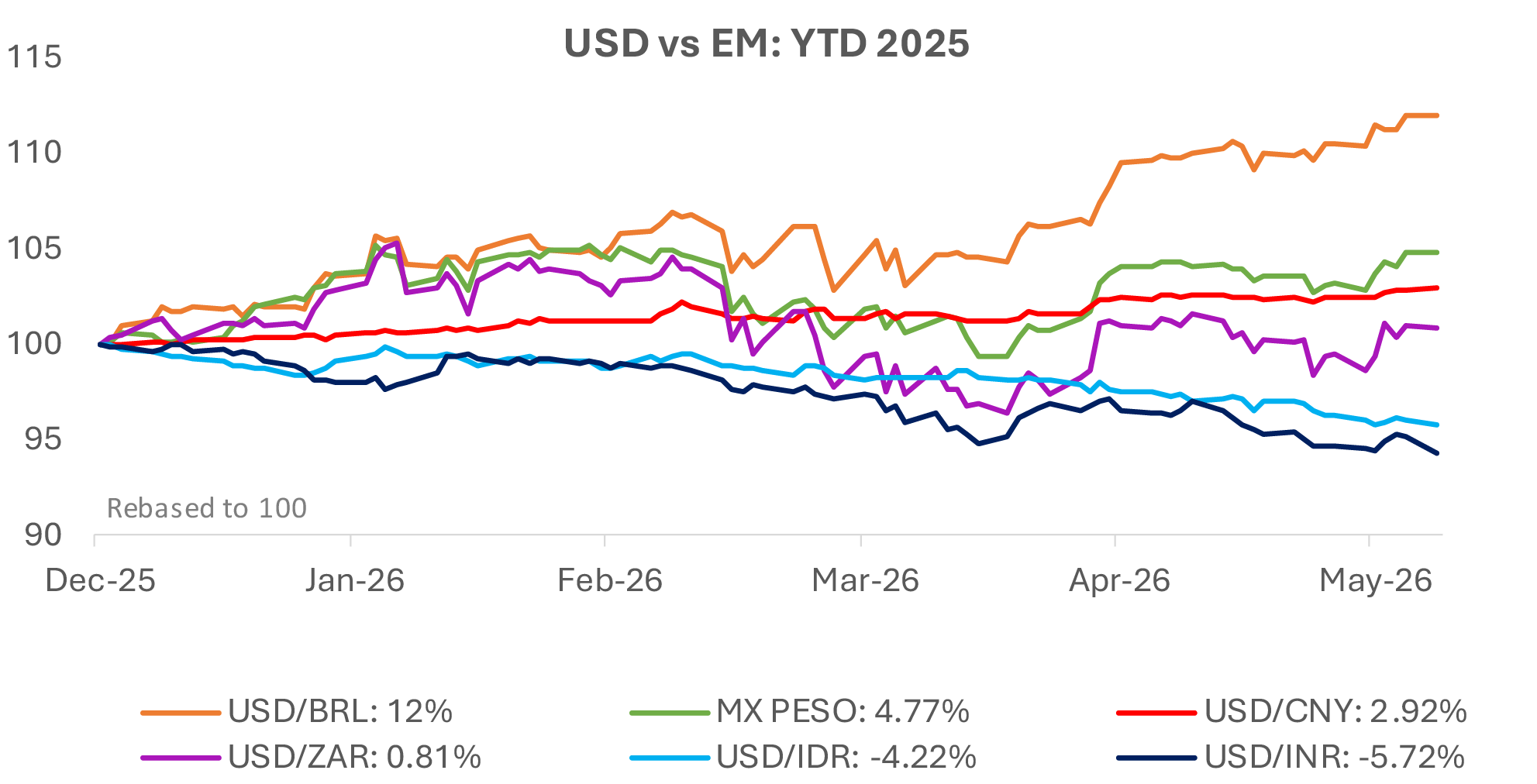
Data Source: Refinitiv DataStream. Quantum Graphics. Data from Jan 01, 2026, to May 11, 2026 INR: Indian Rupee, IDR: Indonesian Rupiah, CNY: Chinese Yuan, BRL: Brazilian Real, ZAR: South African Rand, MX PESO: Mexican Peso
What India is experiencing today is not merely currency volatility. It could be the visible symptom of emerging structural stress in the country’s external sector.
So is the RBI merely smoothing excessive volatility or is it attempting to resist a fundamentally necessary adjustment in the rupee?
Because the distinction matters. If the rupee is weakening because of short-term panic or speculative positioning - intervention can restore stability. But if depreciation reflects something more structural - persistent import dependence, weakening export competitiveness, slower capital inflows, and a widening current account deficit - then intervention merely delays adjustment while increasing long-term economic costs.
Increasingly, the evidence points to the latter.
So why is the Rupee depreciating?
The rupee’s depreciation is not a one-off event tied to a single geopolitical episode. Multiple structural forces are converging simultaneously.
1) India’s Energy Dependence Remains Its Biggest Vulnerability
India imports nearly 85 - 90% of its crude oil requirements, along with large volumes of LNG and LPG. Much of this energy flow passes through the Strait of Hormuz, leaving the economy acutely exposed to disruptions in West Asia.
Every spike in oil prices sets off a familiar chain reaction:
• India’s import bill rises sharply
• Importers demand more dollars
• The trade deficit widens
• Dollar demand overwhelms rupee demand
The result is mechanical downward pressure on the rupee.
This time, however, the pressure is amplified by rising freight costs, supply-chain disruptions, and higher fertilizer imports as well. And as a consequence, is a rapidly deteriorating current account position.
Chart III: Costlier Crude Continues to Deepen India’s Oil Deficit
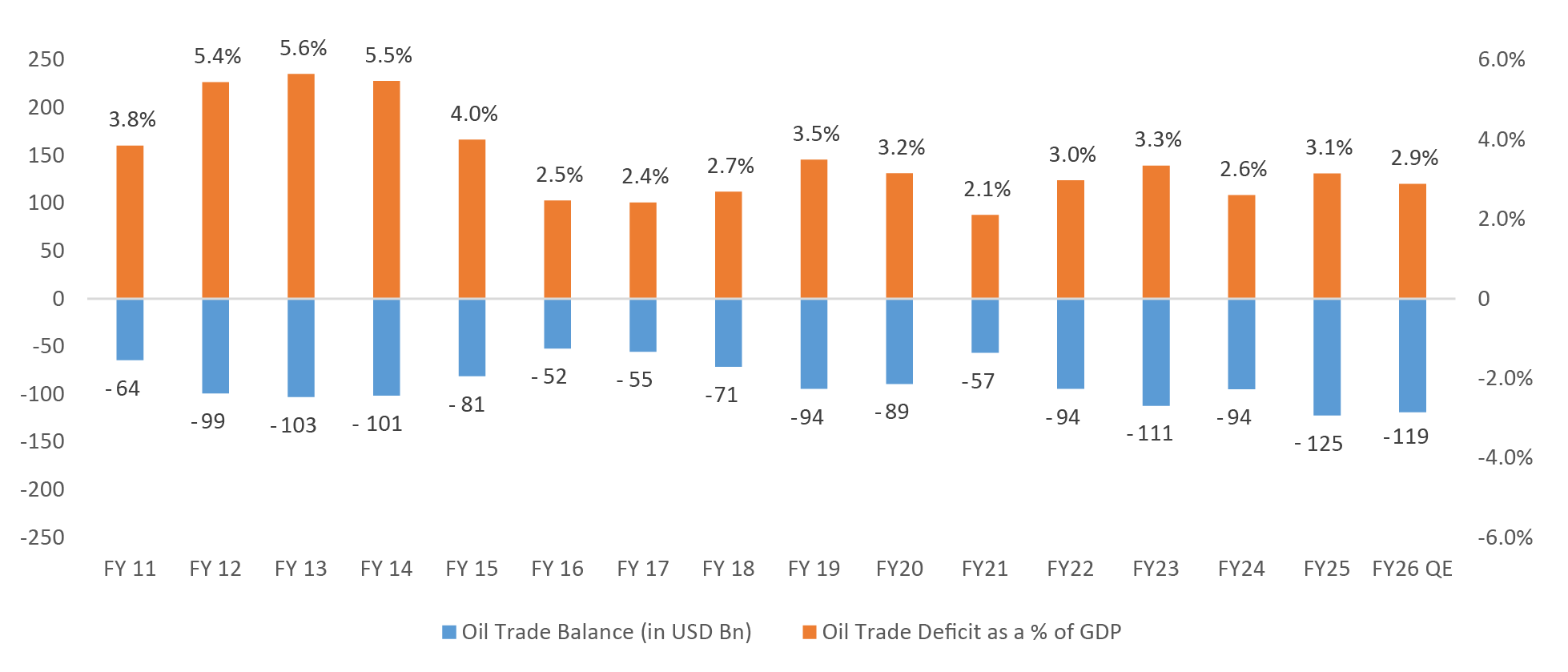
Data Source: CMIE. Quantum AMC Graphics. Data up to FY 25 and QE: Quantum Estimates for FY 26
Back of the hand calculations suggest that every $10-per-barrel rise in crude prices can widen India’s current account deficit by roughly 0.3 - 0.4% of GDP. For a structurally import-dependent economy, that is not a merely a marginal shift, it is macroeconomically significant.
2) The Capital Flow Problem Is Becoming More Serious
India has historically financed its current account deficits comfortably through foreign capital inflows - portfolio investments, foreign direct investment, external commercial borrowings, and remittances.
But that equation has become less reliable.
Over FY25 and FY26, India witnessed sustained foreign portfolio outflows amid:
• elevated US interest rates,
• geopolitical uncertainty,
• concerns around Indian equity valuations,
• slowing global trade,
• weakening optimism around India missing out on the AI race.
Even net FDI inflows have moderated materially.
Chart IV: India, over the last 5 years Either had a CAD Surplus or Strong Capital Inflows — Now It Has Neither
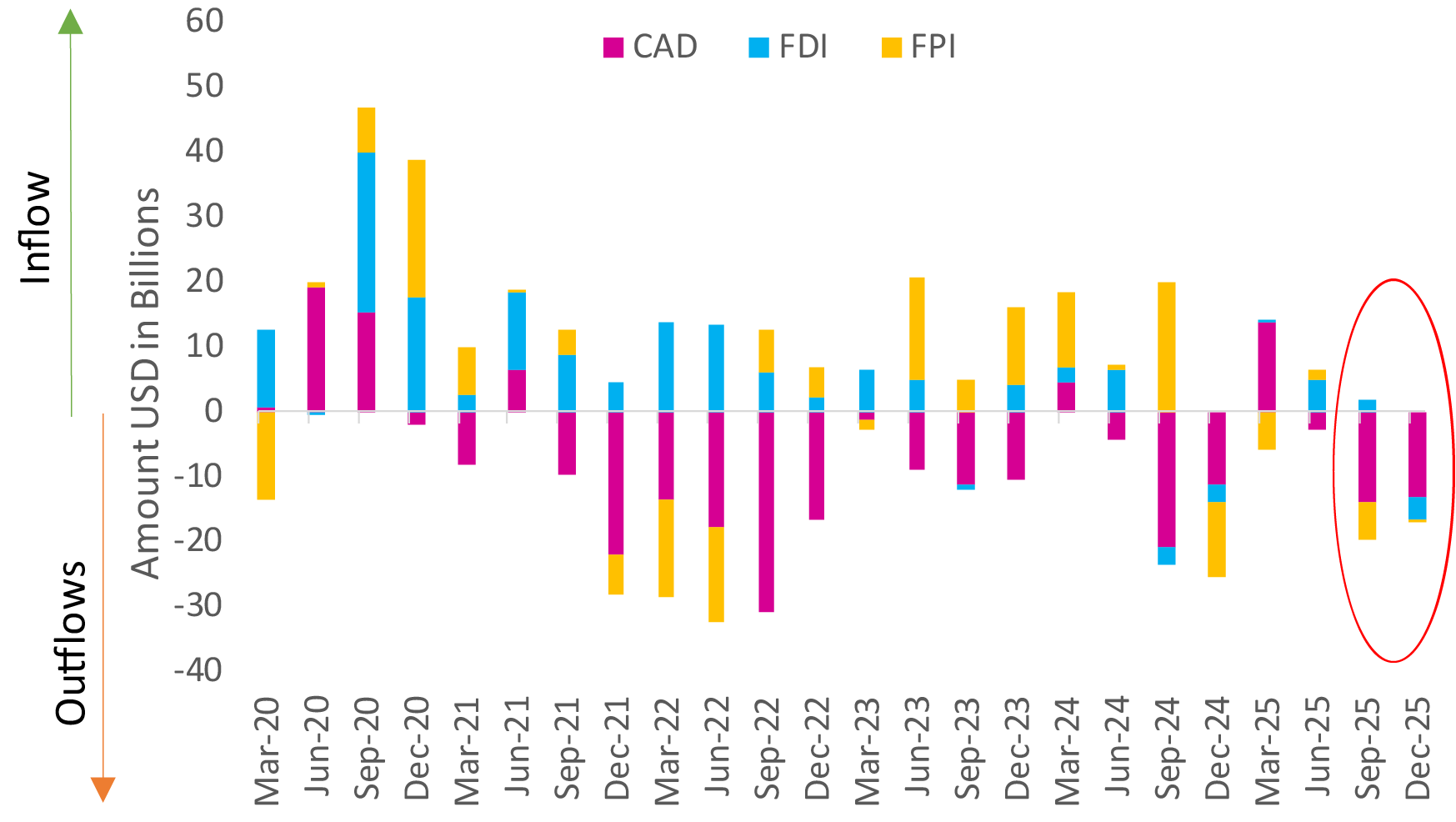
Data Source: CMIE. Quantum AMC Graphics. Data for the Quarter ended December 2025.
This matters because current account deficits are sustainable only when capital inflows comfortably finance them. India seems to be increasingly approaching a zone where financing even a moderate deficit requires far greater policy effort and market confidence than before.
This is alarming not the rupee level itself.
3) India’s Export Engine Is Still Structurally Weak
A resilient external sector typically stabilizes the currency by generating steady, diversified foreign exchange inflows that offset volatility in capital flows. In India’s case, that cushion remains limited despite the broader growth narrative.
Exports remain relatively concentrated. Services exports (led by IT and business services) form a large share, but they are increasingly cyclical and sensitive to global tech spending. Merchandise exports are still heavily skewed towards petroleum products, which rely on imported crude, limiting their net foreign exchange impact. Sectors such as gems and jewellery add value but remain vulnerable to global demand swings and discretionary consumption cycles, while manufacturing exports are still largely concentrated in lower-to-mid value segments with limited pricing power.
As a result, India’s export base lacks sufficient depth and diversification to consistently generate strong counter-cyclical inflows. This leaves the external account more exposed to volatile financial flows, rather than being anchored by stable trade surpluses.
Chart V: Services lead India exports, without export diversification, currency stability remains externally dependent
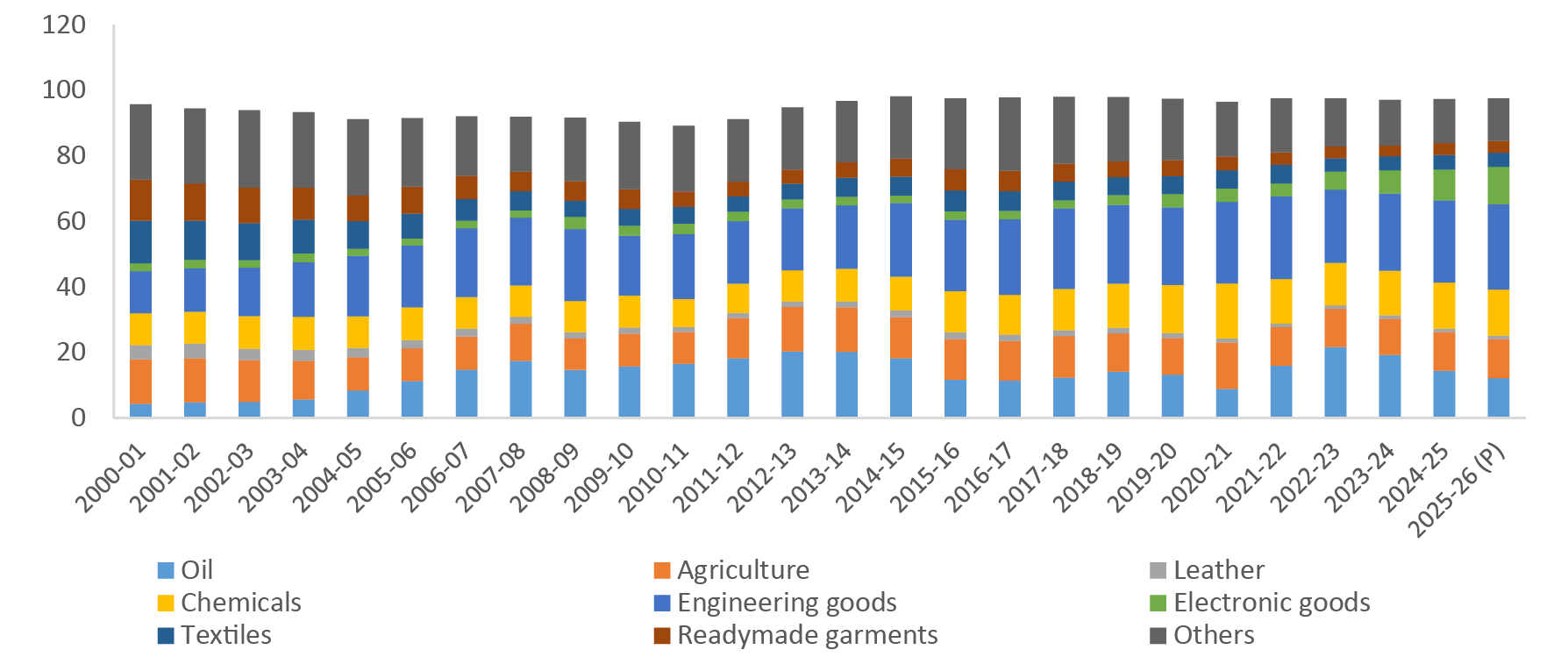
Data Source: CMIE. Quantum AMC Graphics. Data for the FYE 2026. Numbers for FY 2025-26(P) indicate provisional.
Meanwhile, China continues to dominate global manufacturing supply chains, while countries such as Vietnam and Mexico have steadily captured export market share that many expected India to absorb.
Despite production-linked incentive (PLI) schemes and policy ambition, India’s manufacturing export competitiveness has improved more slowly than anticipated.
That leaves the rupee without a sufficiently strong export earnings base.
The Current Account Deficit Is the Core Story
At the heart of the rupee debate lies a more fundamental imbalance: the current account deficit (CAD). Now CAD captures the gap between what India earns from the rest of the world and what it spends abroad. When this gap widens, the economy becomes increasingly dependent on foreign capital inflows to sustain domestic consumption and investment.
Historically, India was able to finance CADs above 2% of GDP without significant stress, largely because global liquidity was abundant and investors were willing to aggressively allocate capital to emerging markets. In that environment, even persistent external gaps were comfortably funded. But that backdrop has shifted materially.
Global liquidity is now tighter, investors are more discriminating, geopolitical fragmentation is reshaping capital allocation, and India’s relative growth premium is no longer taken for granted in the same way.
The issue, therefore, is not whether the CAD is widening. It is whether India can still attract sufficient and stable foreign capital to finance it without disruption.
Because when that balance weakens, pressure does not remain confined to the external accounts, it transmits into the currency.
And it is precisely this transmission channel that is now pushing the Reserve Bank of India into a more active and multi-layered response.
RBI’s Intervention Is Becoming Increasingly Aggressive
The Reserve Bank of India has responded through an increasingly aggressive mix of spot dollar sales, forward-market intervention, FX swaps, liquidity injections and regulatory tightening. In March 2026, the RBI capped banks’ net open USD-INR positions at $100 million, restricted participation in offshore non-deliverable forward (NDF) markets, barred rebooking of cancelled derivative contracts and tightened oversight of speculative arbitrage activity between onshore and offshore currency markets. Reuters also reported that the central bank conducted more than $2-3 billion in FX swaps in January alone to offset liquidity pressures created by its intervention the objective is to control volatility.
But the scale and persistence of intervention increasingly suggest something broader: an attempt to influence the exchange-rate level itself.
Chart VI: India’s FX Buffers Look Stronger Than They Really Are, Adjusted for Forwards, India’s Currency Reserves Are much Lower
Data Source: CMIE, Quantum AMC Graphics. Data for the year ended March 2026.
India’s foreign-exchange reserves remain substantial, but intervention is not costless.
Defending a currency for prolonged periods creates forward liabilities, reduces reserve buffers, and can eventually weaken market confidence rather than strengthen it.
Markets are often more comfortable with orderly depreciation than with the perception that policymakers are actively resisting what appears to be a broader structural adjustment. That distinction sits at the heart of the debate on currency management today.
A) The Case for RBI Intervention Is Still Legitimate
To be fair, the RBI’s concerns appear reasonable because - a disorderly rupee collapse could:
• intensify imported inflation,
• increase fuel and fertilizer costs,
• destabilize corporate balance sheets with dollar liabilities,
• and create financial-market panic.
In a country where food and fuel inflation carry enormous political and social sensitivity, exchange-rate management becomes more than a merely technical monetary-policy issue.
The RBI is therefore justified in preventing broader overshooting.
But there is a critical difference between smoothing volatility and suppressing structural adjustment.
And that distinction is becoming increasingly blurred.
B) Currency Markets Eventually Overpower Administrative Resistance
Currency intervention works best when shocks are temporary.
It becomes far less effective when underlying structural imbalances remain unresolved.
India’s current challenge is increasingly structural (as explained earlier):
• energy dependence remains high,
• export competitiveness remains uneven,
• capital inflows are slowing,
• and import intensity continues to rise.
Under such conditions, defending a currency indefinitely becomes both expensive and counterproductive
Administrative controls, if overextended, can carry their own set of risks.
Measures such as restrictions in offshore markets and tighter oversight of foreign exchange positioning may help moderate speculative pressures in the short term. However, they can also raise concerns around policy predictability, market depth, and the ease of hedging for market participants.
The signaling channel is particularly important in this context. Even well-intentioned interventions can lead global investors to reassess the policy environment, prompting questions around the potential for additional regulatory measures, the stability of capital account frameworks, and the long-term ease of executing currency hedges.
In such circumstances, uncertainty itself can become a source of market caution, potentially influencing capital allocation decisions over time.
C) A Weaker Rupee Is Not Entirely Negative
There is another uncomfortable reality policymakers often avoid acknowledging publicly: currency depreciation also performs an economic function.
A weaker rupee can enhance export competitiveness, discourage excessive import demand, support domestic substitution, and gradually help correct external imbalances. In that sense, some degree of currency adjustment is not only inevitable but also economically useful. And suppressing depreciation could simply delay that adjustment process.
Is the Depreciation Pressure Likely to Persist?
In our opinion - several structural forces suggest the rupee may continue weakening gradually over the next three to four years.
First, India’s inflation rate consistently exceeds that of advanced economies. Over long periods, currencies with higher inflation almost always depreciate gradually.
Second, India is likely to remain a current-account-deficit economy because its growth model remains heavily import-intensive - particularly in energy, electronics, and manufacturing inputs.
Third, global capital is becoming more selective. Higher US bond yields, geopolitical fragmentation, and concerns around emerging-market risk are changing capital allocation patterns globally.
Fourth, if markets increasingly perceive administrative intervention and policy unpredictability in currency management, India’s risk premium itself may rise over time.
That creates a self-reinforcing cycle of depreciation pressure.
The broad market consensus increasingly points toward managed but continuing rupee depreciation over FY27 - FY29.
Street expectations now broadly imply: ₹95–97 per dollar in FY27, which we believe does not imply a currency crisis.
India still retains substantial macroeconomic strengths:
• strong domestic consumption,
• relatively healthy banking balance sheets,
• large FX reserves,
• and one of the world’s fastest-growing major economies.
But growth alone does not immunize a currency from the external-sector math and the math is becoming increasingly difficult to ignore.
The Bigger Question Policymakers Must Confront
We learned the rupee’s weakness is not a temporary geopolitical shock or a speculative episode. It reflects deeper structural pressures: persistent energy dependence, recurring current account deficits, slowing capital inflows, and uneven export competitiveness.
The RBI can smooth volatility, buy time, and prevent disorderly adjustments, but it cannot indefinitely resist market-driven external correction without creating distortions elsewhere. When fundamentals remain stretched, intervention changes the pace of adjustment, not the direction.
Against this backdrop, attention is turning to the June 2026 RBI monetary policy, with markets broadly pricing in a “higher-for-longer” stance amid persistent currency pressure, sticky imported inflation risks, and external balance concerns. Expectations also point to continued liquidity management through variable rate operations, FX swaps, and calibrated system liquidity support.
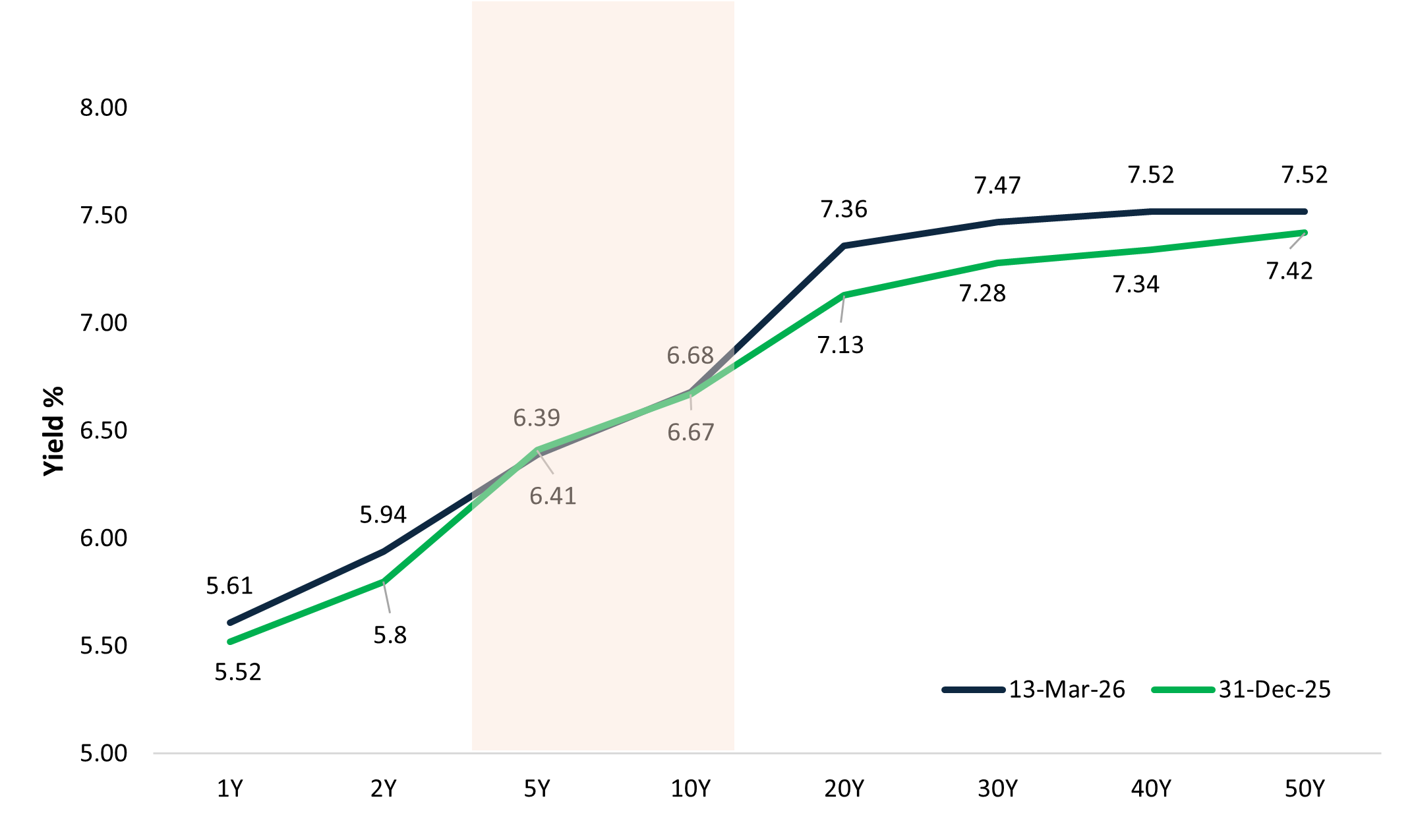
This tension is already visible in bond markets. The 10-year yield has moved to around 7.12% despite a repo rate of 5.25%, while OIS pricing reflects expectations of tighter conditions. Currency volatility, shifting foreign inflow expectations, and evolving liquidity dynamics are all feeding into sharper movements at the shorter end of the curve.
As a result, fixed income markets are becoming more event-driven, where liquidity and duration risk matter as much as the policy rate itself. In this environment, allocation increasingly shifts toward flexibility and risk management. Dynamic bond funds, which can adjust duration across cycles, offer a more adaptive approach. Preference also tilts toward high-quality credit (Government securities and AAA-rated PSU bonds) which tend to be more resilient in volatile rate and currency conditions.
Similarly, liquid funds, with their low duration risk and high-quality portfolios, can provide stability for short-term cash management in an environment where both rate and currency expectations remain fluid.
Unless India strengthens its export base, reduces import dependence, and attracts more stable capital inflows, currency pressure is likely to remain a recurring feature rather than an exception.
The real question, therefore, is no longer whether the rupee will depreciate in cycles. It is whether India can build an external sector strong enough to make those cycles shallower, more predictable, and less disruptive over time. |
Data Source: RBI, Centre for Monitoring Indian Economy
For any queries directly linked to the insights and data shared in the newsletter, please reach out to the author - Sneha Pandey, Fund Manager - Fixed Income at [email protected].
For all other queries, please contact Mohit Bhatnagar - Head - Sales, Quantum AMC at [email protected] / [email protected] or call him on Tel: 9987524548
Read our last few Debt Market Observer write-ups -
- India’s Macro Backdrop: Past Fragility, Present Strength
- What Does the West Asia Crisis Mean for India’s Economy?
Disclaimer, Statutory Details & Risk Factors:The views expressed here in this article / video are for general information and reading purpose only and do not constitute any guidelines and recommendations on any course of action to be followed by the reader. Quantum AMC / Quantum Mutual Fund is not guaranteeing / offering / communicating any indicative yield on investments made in the scheme(s). The views are not meant to serve as a professional guide / investment advice / intended to be an offer or solicitation for the purchase or sale of any financial product or instrument or mutual fund units for the reader. The article has been prepared on the basis of publicly available information, internally developed data and other sources believed to be reliable. Whilst no action has been solicited based upon the information provided herein, due care has been taken to ensure that the facts are accurate and views given are fair and reasonable as on date. Readers of this article should rely on information/data arising out of their own investigations and advised to seek independent professional advice and arrive at an informed decision before making any investments. Mutual Fund investments are subject to market risks, read all scheme related documents carefully. |

View All
Related Posts
-

The Case for the December Pivot
Posted On Monday, Sep 21, 2026
For the last twelve months, Indian fixed income has been a story of comfortable pauses, benign carry, and a gently steepening curve.
Read More -

What Does the West Asia Crisis Mean for India’s Economy?
Posted On Tuesday, Mar 24, 2026
Over the past few years, geopolitics has steadily returned to the center of global economic discussions.
Read More -

Looking Beyond the 10-Year Benchmark: Decoding India’s Bond Market Signals
Posted On Thursday, Feb 26, 2026
If you glance at India’s financial headlines today, the tone feels reassuring.
Read More