
Looking Beyond the 10-Year Benchmark: Decoding India’s Bond Market Signals
Posted On Thursday, Feb 26, 2026

Looking Beyond the 10-Year Benchmark: Decoding India’s Bond Market Signals
If you glance at India’s financial headlines today, the tone feels reassuring. The 10-year benchmark government bond yield is hovering around 6.67% - 6.70% band1, and this is suggesting stability.
But markets often whisper their real story beneath the surface.
Behind this apparent calm, the internal mechanics of India’s debt market are adjusting to a powerful structural shift. This is what the market refers to as a “hump” - a visible bulge in the yield curve that reflects uneven pressures across maturities and is subtly altering the balance of risk and opportunity along the fixed-income spectrum.
For retail investors in debt mutual funds or planning retirement allocations, this is not a minor technical detail but a phase that demands closer attention and thoughtful positioning across maturities.
A Record High Borrowing Program and What It Really Means…
The government’s fiscal plan for FY 2026–27 initially pegged gross borrowings at ₹17.2 trillion. After accounting for the ₹5.5 trillion needed to refinance maturing pandemic-era bonds, the net addition to debt – net borrowing (the real measure of fiscal expansion) comes to ~ ₹11.7 trillion.2
Following the FY 2026-27 Budget, the RBI announced strategic switch operations, exchanging shorter-dated maturities for longer-term paper. This effectively lowered the gross borrowing requirement to around ₹16.2 trillion3.
Chart I: Gross and Net Market borrowings since pandemic
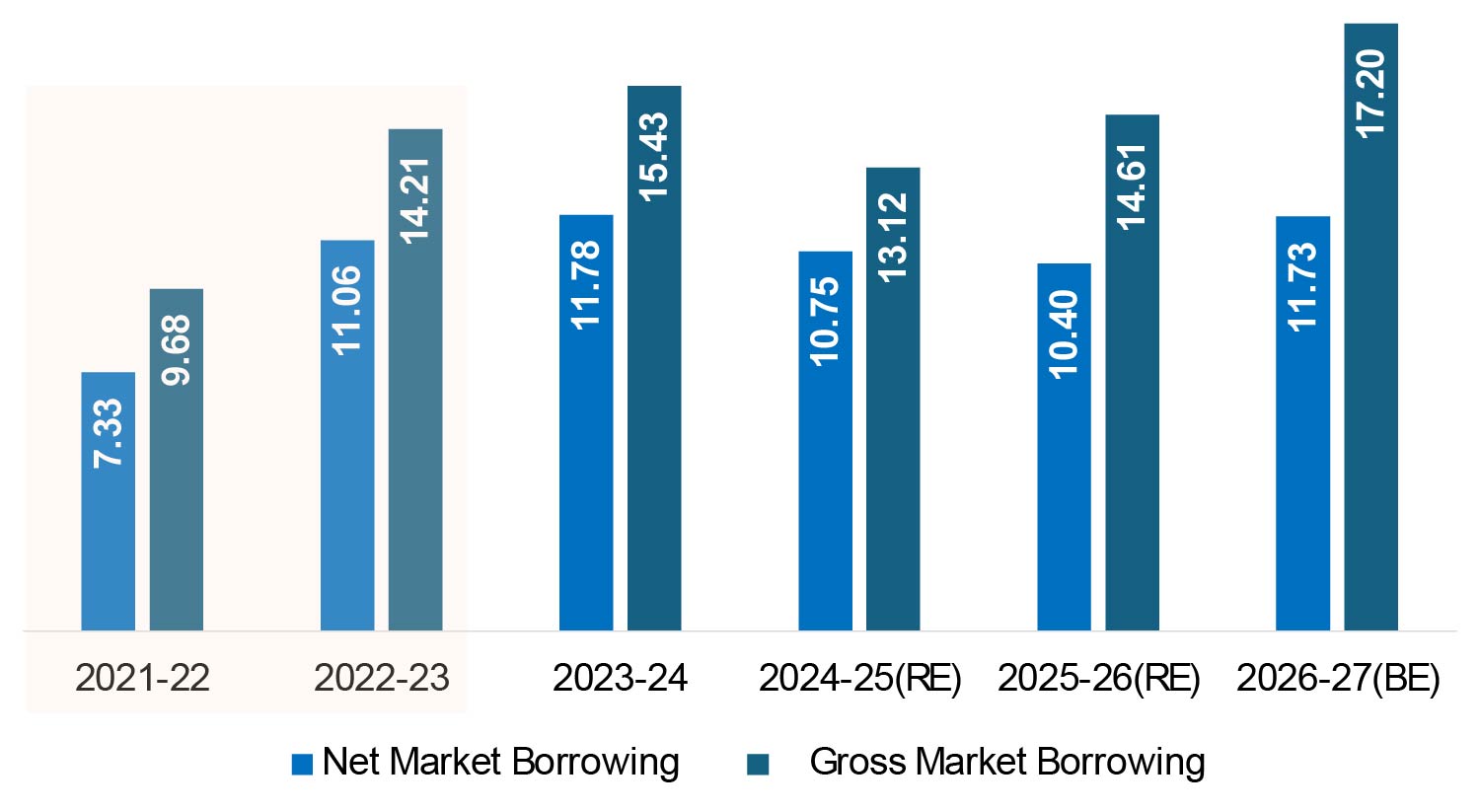
Amount in ₹ Trillion. Source: India Budget Documents. Quantum AMC Graphics. RE: Revised Estimates BE: Budget Estimates. Area Highlighted represents the spike in borrowing post COVID.
While the overall debt stock remains unchanged, the refined maturity profile eases near-term redemption pressures. It is a deft exercise in debt management that balances fiscal discipline with market stability, helping smooth supply-side volatility in the bond market.
This is neither unusual nor alarming in isolation. However, the scale is significant. A large supply of bonds entering the market typically exerts upward pressure on yields, especially in segments where natural demand is limited.
Yet the 10-year benchmark yield has remained contained. That tells us something important about who is absorbing the supply.
The Central Bank’s Balancing Act
As of February 2026, liquidity management through open market operations (OMO) has become a central pillar of India’s bond market stability. The Reserve Bank of India has absorbed a substantial share of the government’s borrowing program via secondary market purchases, injecting durable liquidity at a time when gross supply remains elevated. These purchases account for a significant proportion of this year’s issuance, effectively cushioning the impact of heavy supply on yields.
This support has been especially critical for the 10-year government security, which functions as the benchmark rate for home loans, corporate borrowing, and valuation models across asset classes. By maintaining active participation in bond purchases and deploying complementary liquidity tools, the RBI has helped prevent disorderly spikes in yields and preserved orderly market conditions. The strategy has reinforced policy transmission and kept broader financial conditions stable, even as refinancing pressures and supply concentrations continue to reshape other segments of the yield curve.
Chart II: RBI’s Net OMO activity - Balancing Record Supply with Strategic Absorption
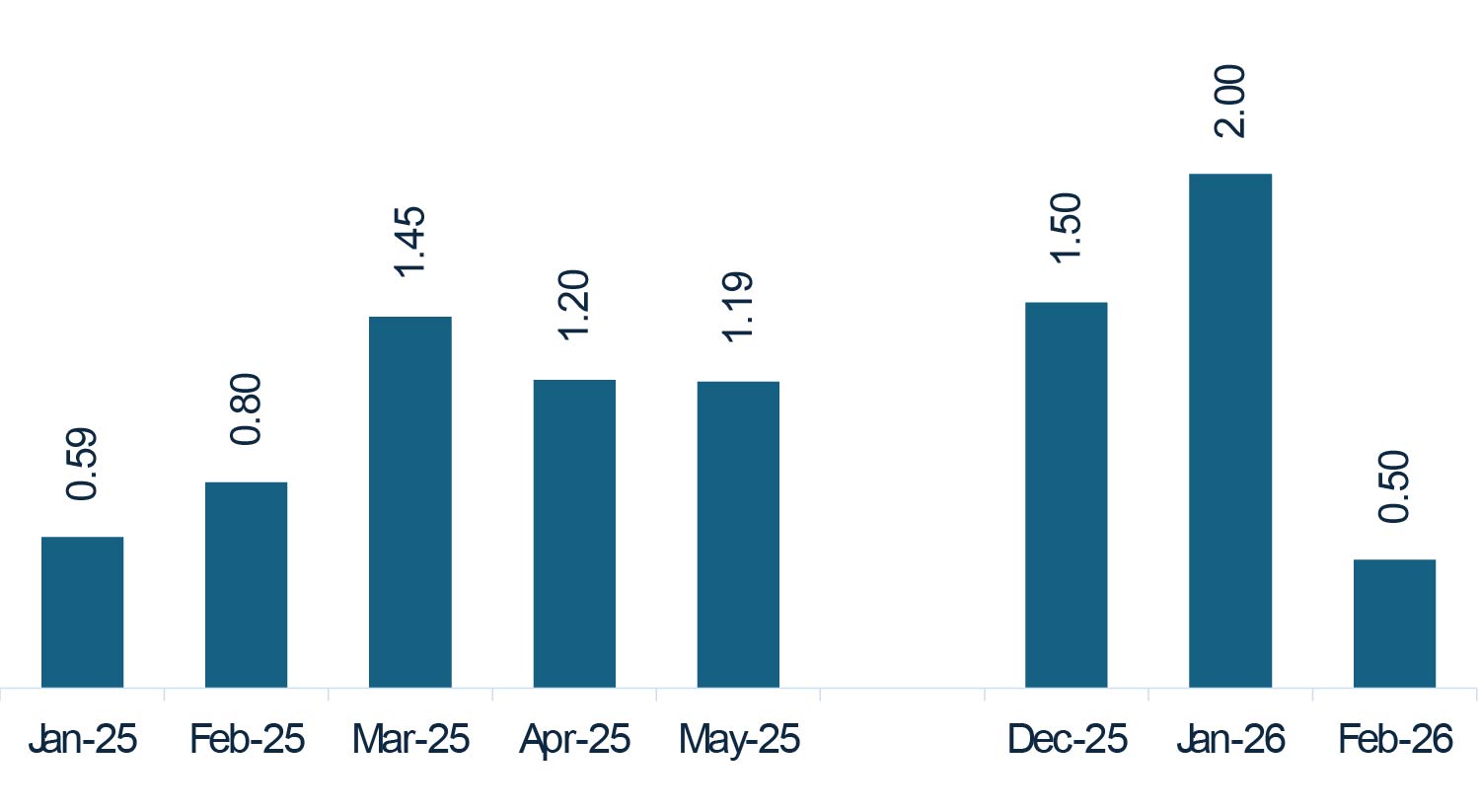
Amount in ₹ trillion. Above figures indicate Net OMO purchases by the RBI since Jan 2025. Source: RBI. Quantum AMC Graphics. Data up to February 24, 2026.
However, when strong institutional support concentrates around a specific maturity, market dynamics elsewhere can evolve differently. That is precisely what we are witnessing.
Understanding the “Hump”: Why the Middle of the Curve Feels Heavier
In a typical environment, longer maturities carry higher yields than shorter ones. Today, parts of the mid-segment, roughly 5 to 15 years, are offering comparatively elevated yields relative to both shorter and ultra-long tenors.
Why?
• Short-term bonds (0–2 years) benefit from banking system liquidity needs and regulatory requirements such as liquidity coverage norms.
• The 10-year benchmark has seen consistent demand, supported by policy operations and its status as the market’s reference instrument.
• Ultra-long bonds (30–40 years) attract structurally committed buyers such as insurance companies and pension funds that manage long-dated liabilities.
Chart III: Policy and Pension Support Anchoring the Extremes While Leaving the Belly Exposed
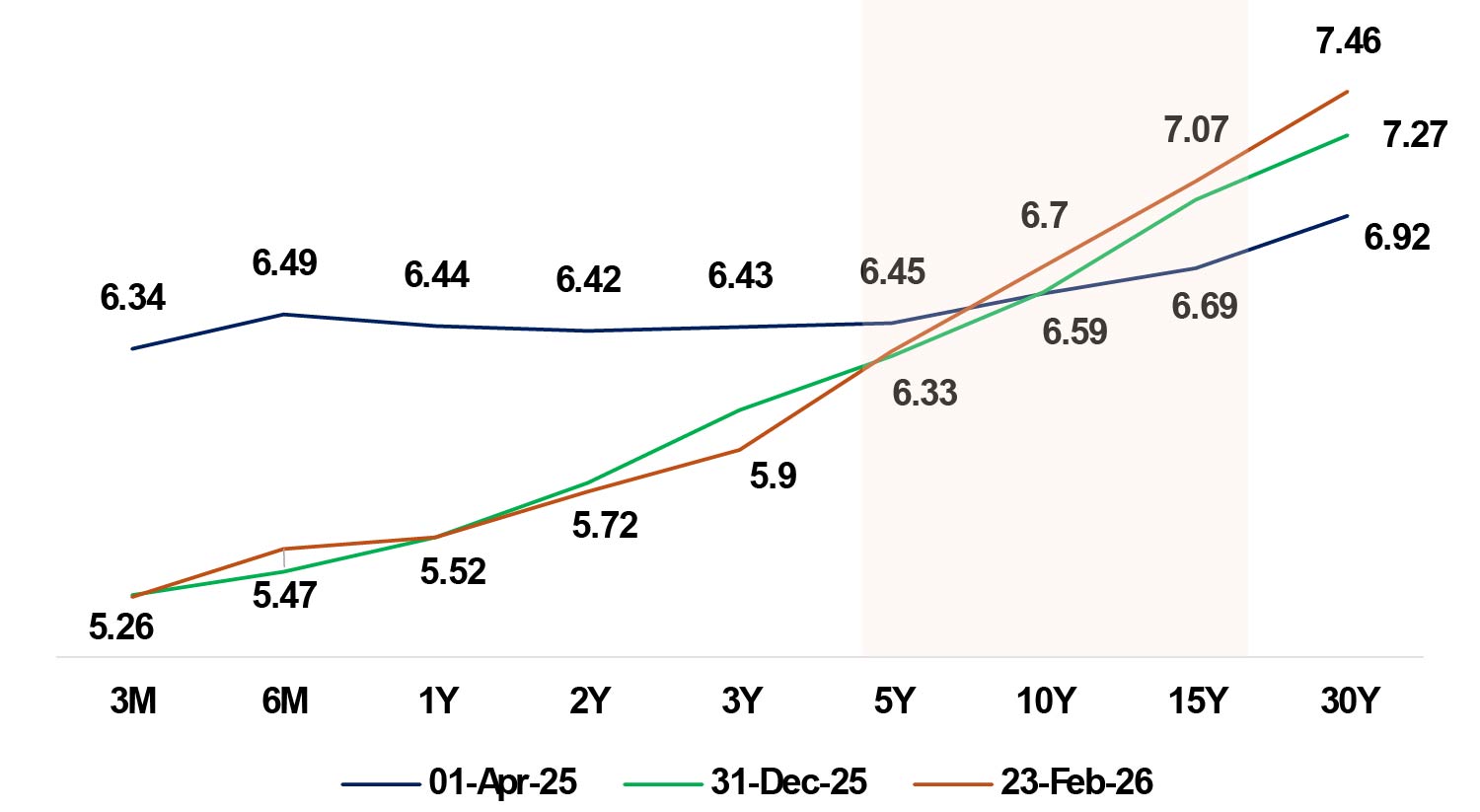
Source: CCIL, RBI, Bloomberg. Quantum AMC Graphics. Data up to February 23, 2026
The 5–15-year segment, by contrast, has experienced heavier net supply without the same degree of concentrated institutional demand. That imbalance has created pressure in what many retail portfolios traditionally consider “middle-of-the-road” maturity exposure.
So hypothetically, if an investor were to hold medium-duration debt funds (typically invested in the 5–9- year segment), they may notice mark-to-market volatility, even though headline interest rates appear stable.
This is not a signal of systemic stress. It is a reminder that duration positioning matters now more than ever.
Positioning Strategies and Key Considerations for Investors in Today’s Yield Environment
Given the current shape of the yield curve, a prudent strategy is to adopt a “barbell” allocation focusing on the short and ultra-long maturities, while maintaining selective and measured exposure to the mid-segment.
1. The Short End: Stability Through Liquidity: Treasury bills and short-duration instruments benefit from structural demand created by regulatory liquidity requirements. For retail investors, well-managed liquid and money market funds may offer attractive risk-adjusted profiles in such an environment.
2. The Ultra-Long End: Liability Matching Support: Insurance and pension funds operate with long-term payout commitments. To match those liabilities, they allocate to 30- and 40-year government bonds. This steady, long-horizon demand can help anchor yields at the far end of the curve.
Selective long-duration exposure aligned to an investor’s investment horizon and risk appetite may therefore play a strategic role, provided volatility is understood and accepted.
In a structurally evolving bond market, broad participation may give way to selective positioning.
1. Duration Awareness Is Essential: Understand where the debt fund sits on the curve. Medium-duration exposure may experience more sensitivity in a supply-heavy environment.
2. Monitor Policy Signaling: Any moderation in central bank bond purchases could influence yield stability, particularly in benchmark maturities. Policy communication will remain a key driver.
The Bigger Picture
India’s bond market in 2026 is not unstable but it is nuanced.
The interaction between fiscal borrowing, refinancing needs, regulatory demand, and central bank operations has reshaped the yield curve in ways that reward informed allocation.
For retail investors, the takeaway is - fixed income is no longer a passive corner of the portfolio. It requires an agile and adaptive design. By understanding where structural demand is strongest and where supply pressures are most visible you may position your portfolio not merely to withstand volatility, but to benefit from clarity when others rely solely on headlines.
Conservative investors could focus on low duration funds, review credit quality, and reinvest gradually rather than chasing yield moves. Short- and low-duration funds offer stability, while high-quality corporate bond or dynamic bond funds with a blend of high quality SDLs, G-secs and AAA-rated PSUs can provide better carry without adding credit risk.
Long-duration or gilt funds may benefit from easing yields, but come with higher volatility. Until a durable demand source, such as global index inclusion, emerges, bond yields are likely to remain range-bound, supported by policy but constrained by supply.
Data Source: 1Bloomberg, 2India Budget Documents, 3RBI, Ministry of Statistics and Program Implementation (MOSPI), Controller General of Accounts (CGA)
For any queries directly linked to the insights and data shared in the newsletter, please reach out to the author - Sneha Pandey, Fund Manager - Fixed Income at [email protected].
For all other queries, please contact Mohit Bhatnagar - Head - Sales, Quantum AMC at [email protected] / [email protected] or call him on Tel: 9987524548
Read our last few Debt Market Observer write-ups -
- From Fiscal Math to Market Outcomes: What Changes for Bonds as FY26 Ends
- Why Are Bond Yields Still High Despite Rate Cuts?
Disclaimer, Statutory Details & Risk Factors:The views expressed here in this article / video are for general information and reading purpose only and do not constitute any guidelines and recommendations on any course of action to be followed by the reader. Quantum AMC / Quantum Mutual Fund is not guaranteeing / offering / communicating any indicative yield on investments made in the scheme(s). The views are not meant to serve as a professional guide / investment advice / intended to be an offer or solicitation for the purchase or sale of any financial product or instrument or mutual fund units for the reader. The article has been prepared on the basis of publicly available information, internally developed data and other sources believed to be reliable. Whilst no action has been solicited based upon the information provided herein, due care has been taken to ensure that the facts are accurate and views given are fair and reasonable as on date. Readers of this article should rely on information/data arising out of their own investigations and advised to seek independent professional advice and arrive at an informed decision before making any investments. Mutual Fund investments are subject to market risks, read all scheme related documents carefully. |

View All
Related Posts
-

What Does the West Asia Crisis Mean for India’s Economy?
Posted On Tuesday, Mar 24, 2026
Over the past few years, geopolitics has steadily returned to the center of global economic discussions.
Read More -

Looking Beyond the 10-Year Benchmark: Decoding India’s Bond Market Signals
Posted On Thursday, Feb 26, 2026
If you glance at India’s financial headlines today, the tone feels reassuring.
Read More -

Positioning for Disinflation
Posted On Friday, Jan 27, 2023
We are well past the peak inflation of 2022. Yet, inflation continues to be the focal point of all the policy discussions and investment thesis in 2023.
Read More