
Are Indian G-Secs Mispriced Amid Sticky Global Yields?
Posted On Friday, Jul 24, 2026

The story of India's bond market in the first half of CY26 is best understood as a tale in three acts.
The first act, from January to March, followed a familiar script. Strong domestic data but fears of rising government borrowing, and escalating tensions in the Middle East all pushed yields higher. When oil briefly surged above $100 a barrel1 amid the Iran conflict, the 10-year G-sec rose to around 7.1%2 and markets priced in the risk of higher inflation.
The second act, from April to June, reversed that narrative. Expectations of India's inclusion in the Bloomberg Global Aggregate Index drew in foreign investors, while softer US data eased fears of further Federal Reserve tightening. The result was a sharp rally that pulled the 10-year yield lower by nearly 40 basis points3 despite continued geopolitical uncertainty.
The third act is where the story becomes interesting. By mid July, the Iran conflict had intensified again, Brent crude briefly crossed $90 a barrel, and global risks looked similar to those that had driven yields sharply higher just months earlier. Yet this time, Indian bond yields barely reacted, remaining close to the lows of their recent rally.
That divergence is the central puzzle this piece seeks to examine.
Why did the same geopolitical shock lead to two very different market responses within a span of four months?
Has India's sovereign bond market undergone a structural repricing, or is its resilience simply being sustained by strong foreign inflows that may not last? The case is not one-sided. The evidence points in both directions, and understanding which explanation is more convincing matter for every fixed-income investor.
I'll examine both perspectives in the sections to follow.
The Current Market Backdrop
Let's start with the global backdrop, because Indian G-Secs cannot be understood in isolation from it, and because the phrase "sticky global yields" is not a rhetorical flourish. It is the defining feature of fixed income markets in mid-2026.
The Federal Reserve, under its new chair Kevin Warsh, held rates at 3.50% - 3.75%4 at its June meeting, and the minutes released on July 8 struck a notably hawkish tone. The Committee voted unanimously to hold, but more tellingly, dropped language that had previously signaled an easing bias, and lifted its median rate projection for end-2026 to 3.8% from 3.4%5 - citing tariffs, supply-chain disruption, and robust AI-related capital spending as forces keeping inflation stubbornly above target. Markets are now pricing meaningful odds (reportedly around 64% ) that the Fed's next move by September 2026 could be a hike rather than a cut. Eighteen months ago, the consensus was a Fed cutting into 2026 - Today, the debate has reversed entirely.
Chart I: U.S. Treasury: Disinflation Supports the Front End, Fiscal Concerns Lift the Long End
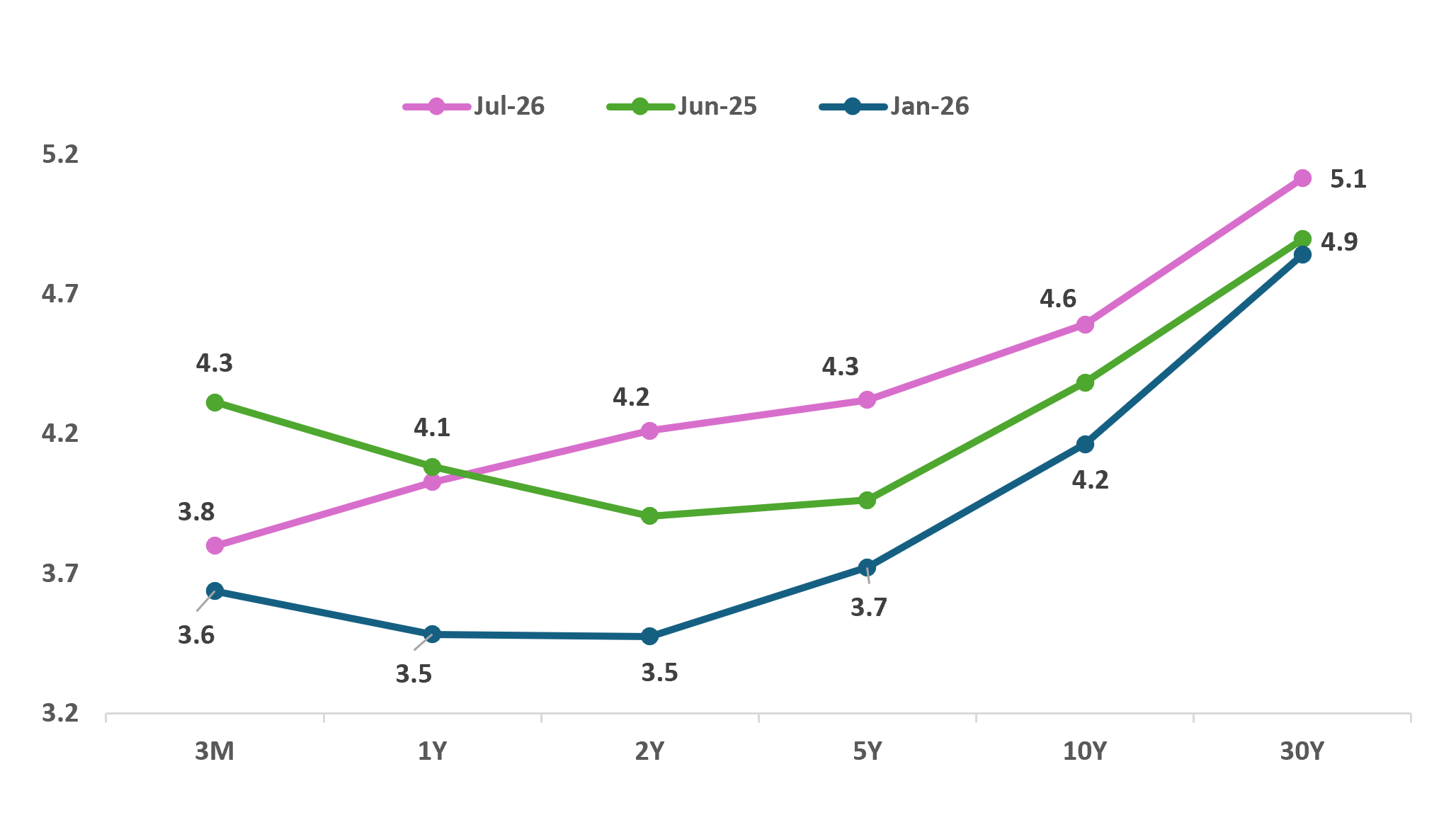
Data Source: LSEG, DataStream. Data up to July 20, 2026. Above data represents U.S. Treasury yields for respective maturity for the following periods - July 20, 2026, January 2026 (start of the calendar year) and June 2025 (a year ago)
Adding to this is the West Asia War that has refused to fully settle…
The interim US-Iran agreement signed on June 17 was supposed to be the moment oil found its ceiling. Instead, by early July, tanker attacks in the Strait of Hormuz (a corridor that carries roughly a fifth of the world's oil and gas trade) had reignited hostilities.
By July 12, the US had reportedly carried out its fourth strike on Iran in a single week, Iran claimed to have closed Hormuz “until further notice” (a claim US Central Command disputed), and Brent - having fallen over 21% in June alone on hopes of peace - was back above $78 - $79 a barrel6. This is a market oscillating between de-escalation rallies and re-escalation shocks, with every swing showing up first in oil, then in inflation expectations, then in the long end of sovereign curves worldwide.
Chart II: Oil Remains the First Responder to Geopolitical Risk
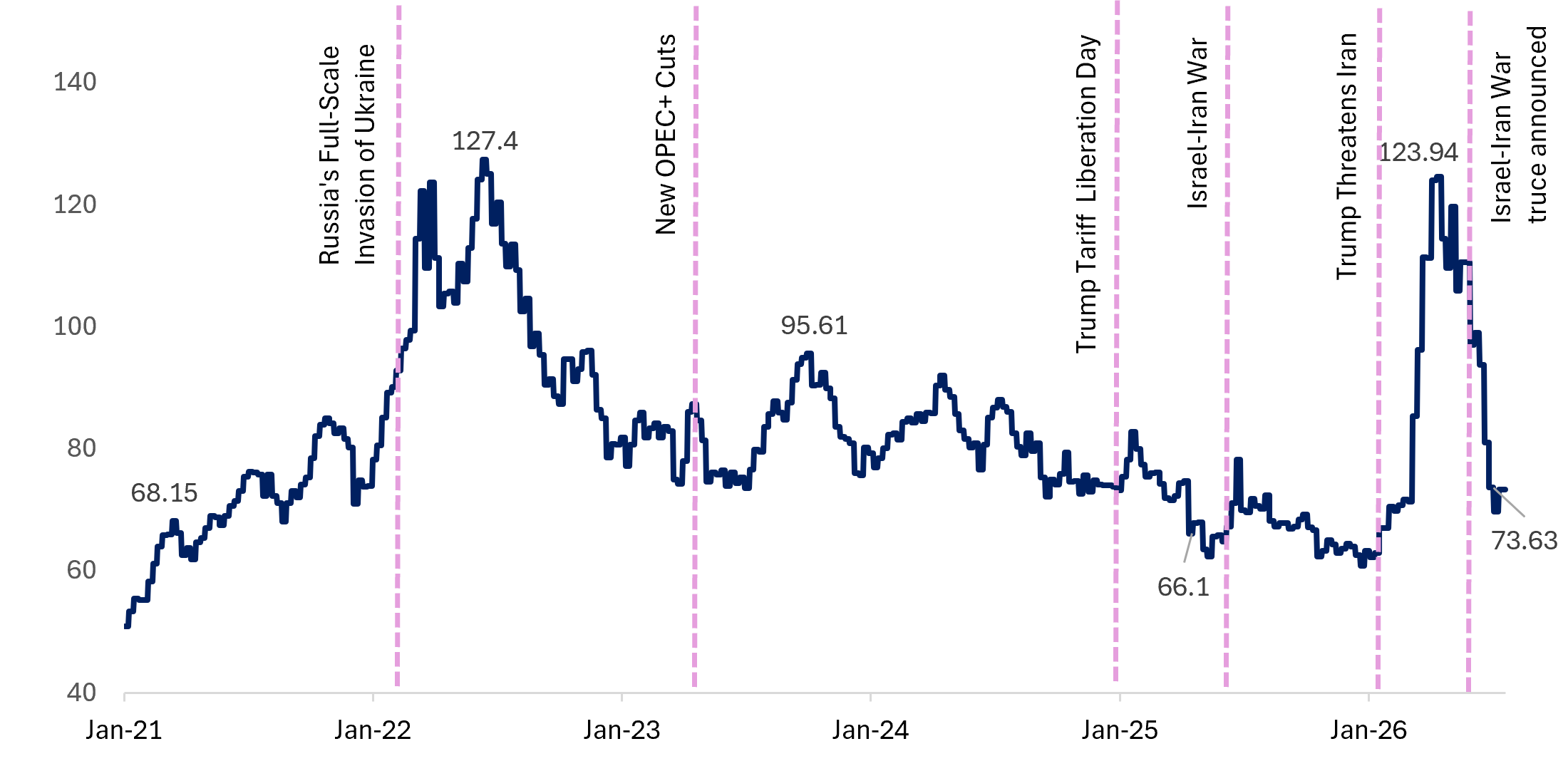
Data Source: Source: LSEG, DataStream. Data up to July 20, 2026. Above data represents Brent Crude Oil prices in USD/ bbl for the last five years
The result is a US Treasury curve that looks calm on the surface - the 10-year yields have held in a fairly narrow 4.3% - 4.6% 7band for weeks… But is stubbornly unwilling to rally..
That stickiness is the anchor against which every emerging-market bond, including India's, is currently being priced. When the risk-free rate of the world's reserve currency won't come down, textbook logic says riskier assets would demand a wider spread to compensate, not a narrower one.
Indian G-Secs are doing the opposite….
Chart III: A Narrowing Spread Despite Elevated Global Risk-Free Rates
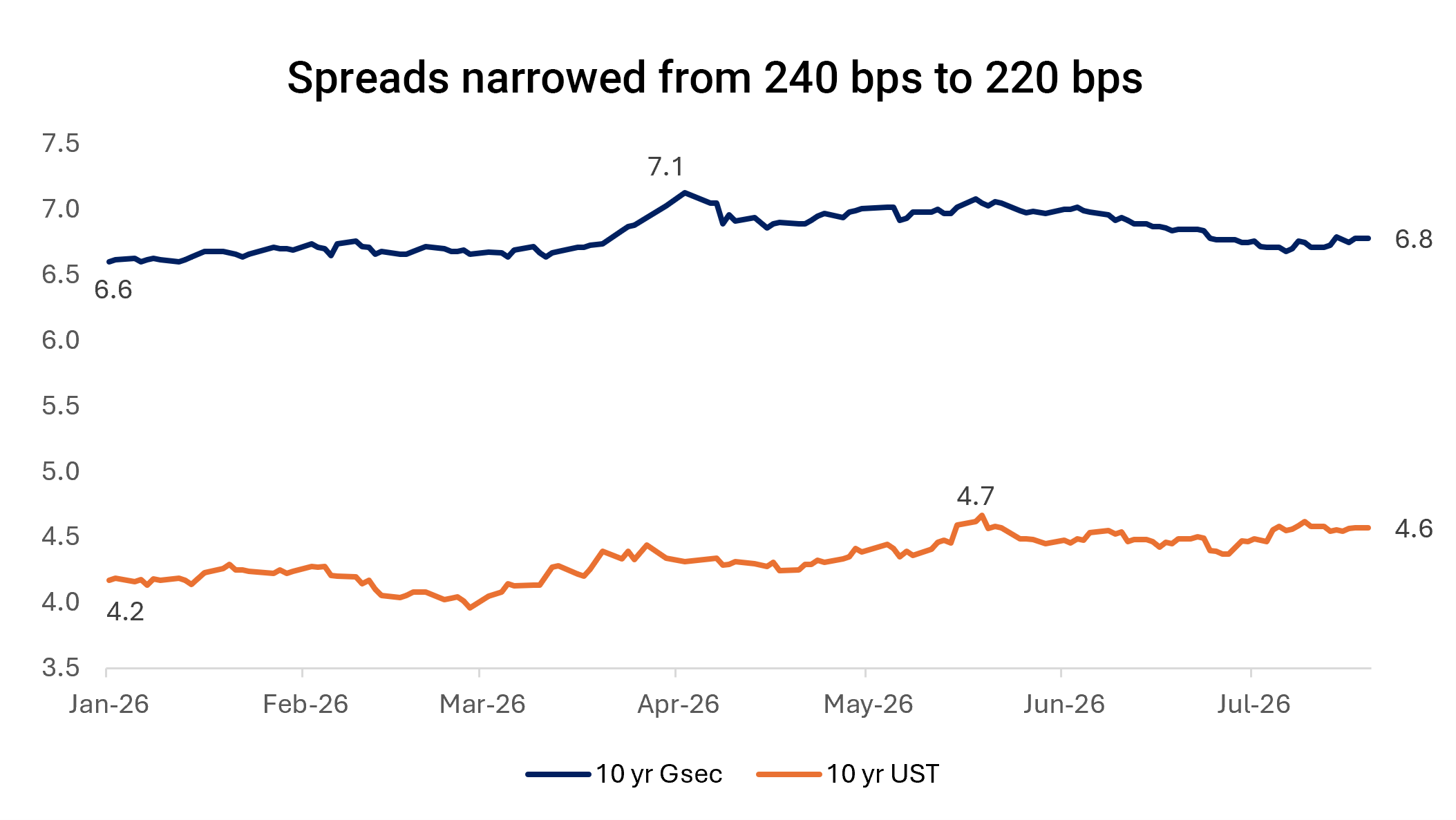
Data Source: LSEG, DataStream. Data up to July 20, 2026. Above data represents bond yields for U.S. Treasury Benchmark 10- year maturity against Indian Government Bond Yields 10-year benchmark in % terms for the calendar year 2026 till date.
What Actually Happened to the Indian Curve
Rewind to late May 2026, when the picture of India was alarming. The rupee had cratered to a record low of nearly 97 to the dollar.
The RBI's June Monetary Policy Committee meeting captured the mood. Policymakers cut the FY27 GDP growth forecast to 6.6% from 6.9%8, and more tellingly raised the FY27 CPI inflation forecast sharply, to 5.1% from 4.6%8, citing the West Asia conflict, elevated energy prices, supply-chain disruption, and monsoon uncertainty.
Wholesale price inflation had spiked to 9.7% in May, even as retail CPI stayed more contained at 3.9%.8 This was, on paper, an environment that should have sent G-Sec yields higher, not lower.
Instead, something unusual happened. On the very day the MPC held rates at 5.25% and delivered that gloomier growth-inflation mix, it also unveiled a coordinated set of capital-account measures: the Fully Accessible Route (FAR) was widened to cover all new 15, 30 and 40 year government securities, investment limits for FPIs under the General Route were scrapped entirely, equity caps for NRIs and OCIs were raised, and temporary FCNR(B) and forex liquidity facilities were introduced. The government moved in parallel, scraping capital gains and withholding tax on eligible FPI investment in government securities, backdated to April 1, 2026.
Chart IV: A Bond Rally Against the Macro Odds
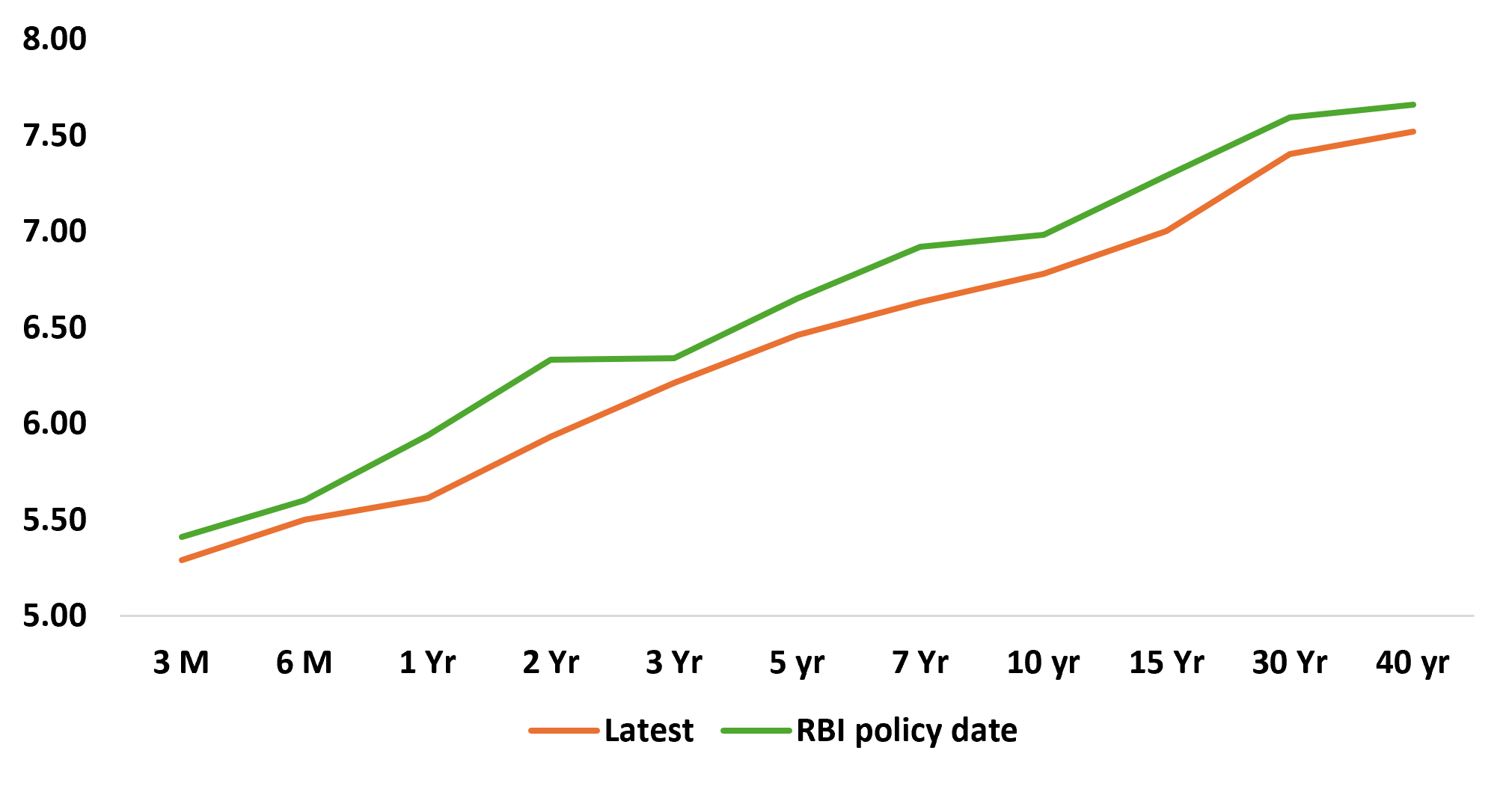
Data Source: NSE Cogencis. Above data represents bond yields for Indian Government Bonds in % terms on RBI policy date – 5th June, 2026 and latest(up to July 17, 2026).
The market's response was swift…
The rupee staged its biggest single-day gain in over two months, recovering from that ~97/$ low to around 94.4/$ by late June (it has since settled in the 95.0 - 95.6 range through mid-July as oil volatility returned)9. FPI inflows into Indian debt under FAR hit a record ₹42,500 crore in June alone - the highest monthly inflow ever recorded, well above the previous record of ₹22,000 crore set in August 202410.
That was enough, on its own, to more than offset the ₹49,340 crore10 foreign investors pulled out of Indian equities in the very same month - a notable rotation of foreign capital from Indian stocks into Indian bonds.
And the 10-year G-Sec yield, which had touched 7.14% in April amid a fresh bout of oil-driven volatility, eased steadily to close at 6.68% on July 7 - a near four-month low, down roughly 46 basis points, even as Brent whipsawed between $71 and $85 and the US 10-year Treasury held stubbornly above 4.3%11.
So a structural story appears to be doing much of the heavy lifting here - India's prospective inclusion in the Bloomberg Global Aggregate Index.
India's phased inclusion in the JPMorgan GBI-EM index, completed some time ago at the maximum permitted 10% weight, is estimated to have already brought in $20–25 billion12 of passive, benchmark-mandated capital over roughly ten months.
This is capital that doesn't pause to weigh this quarter's fiscal deficit. It flows simply because index rules call for it. But that inflow now sits largely in the market's rear-view mirror…It's a stock of capital already absorbed, not a fresh one...
Bloomberg Index Inclusion is where the market's attention has since shifted. In January 2026, Bloomberg Index Services had deferred India's inclusion in its flagship Global Aggregate Bond Index (a benchmark tracked by an estimated $2–3 trillion 13of passive global assets) citing unresolved settlement infrastructure and taxation concerns.
The June tax exemption and FAR expansion appear, by most accounts from market participants and government sources, to have been designed with precisely those hurdles in mind, ahead of Bloomberg's next review. Media reports suggest that review was scheduled for mid-June 2026, with India potentially securing around a 1% weight (worth an estimated $20–25 billion in additional inflows spread over 10-12 months), though some reporting suggests the actual inflows may not land until FY28 even if the announcement comes sooner.
And as markets often do, they appear to be trading the anticipation rather than waiting for the event itself...
Which brings us to where things stand today. As of July 22, 2026, India's 10-year G-Sec is rangebound near its lowest levels in roughly four months, in a year when the RBI has raised its own inflation forecast, cut its own growth forecast, and watched the currency touch a record low - even as a combination of regulatory reform and index-inclusion anticipation has pulled in more foreign capital in a single month than in any month in India's history.
That combination is unusual, though not necessarily irrational. But it does suggest a valuation built substantially on a technical, flow-driven foundation, alongside - rather than - purely in place of a fundamental one.
The Case That G-Secs Are Structurally Cheap
It's worth laying out the bull case in full, because it rests on more than flow-chasing alone.
The starting point is real yields. India's 10-year nominal yield of roughly 6.70% - 6.75%, against a headline CPI print of 4.4% in June, implies a real yield comfortably above 2.3%; even using the RBI's more conservative FY27 forecast of 5.1%, it still works out to north of 1.5%14.
The US, by comparison, offers a real yield closer to 2.0% - 2.3% on its 10-year treasuries14 and the Fed has signalled it may need to tighten further, capping how much real compression US investors can expect.
India, in other words, offers a broadly similar real yield. On a like-for-like basis, then, India's real yield is not meaningfully wider than America's right now — which is an interesting observation than “cheap.” Historically, a BBB- rated, current-account-sensitive credit like India has had to offer investors a real yield running well above the US, often by 200–400 basis points, precisely to compensate for weaker fiscal metrics and a more volatile currency.
That premium has now compressed to something close to parity. The bull case reads this as evidence that India's improving credit profile, deeper market access, and structural demand story warrant a smaller risk premium than before (a valid re-rating rather than a mispricing).
The credit story has genuinely strengthened too, and this part is less about flows and more about fundamentals. S&P upgraded India's sovereign rating to 'BBB' from 'BBB-' in August 2025 (its first upgrade in eighteen years) citing sustained fiscal consolidation and a credible inflation targeting framework, with the fiscal deficit projected to decline from roughly 7.3% of GDP toward 6.6% by FY2915.
But that’s just one part of the story. Fitch held India at 'BBB-' the same month, flagging that India's debt-to-GDP ratio of nearly 81% remains well above the 'BBB' median of 59.6%, and Moody's has kept India at Baa3 since 2020. The rating improvement is real, but it currently reflects one agency's view against two others still expressing caution - a nuance that rarely survives the headline.
Then there's the structural demand story, which is durable in a way tactical flows are not. Once Bloomberg formally includes India, mandate-driven demand for Indian long paper could become a permanent feature of the market rather than a one-off event. Global pension funds and insurers have historically had limited access to high-quality, high-real-yield emerging sovereign debt, and India's opening of long-tenor paper under FAR speaks directly to that liability-matching appetite.
CCIL (Clearing Corporation of India Limited) data already shows foreign holdings of these long bonds rising by roughly ₹35,000 crore in just three weeks after the FAR expansion - an early sign of latent demand, not just a promise of it.
Finally, even the weather has turned cooperative. The cumulative monsoon rainfall deficit narrowed sharply from 43.1% to 21% by July 20, 202615, reducing the tail risk of a food-inflation shock that could otherwise force the RBI's hand. Should the monsoon continue to normalize, the RBI's own 5.1% inflation forecast for FY27 could prove somewhat conservative - which, in hindsight, would make today's yields look reasonably attractive....
Put together, this is a coherent case. A real-yield cushion, a credit trajectory that is improving (if imperfectly), and a multi-year demand story from global index inclusion that has arguably only partly played out. On this reading, the June-July rally doesn’t appear to be a bubble. It appears to be a market recalibrating toward fundamentals that had, for years, been underappreciated because of limited foreign access rather than any real deterioration in credit quality.
But Markets Rarely Move in a Straight Line
It is equally important to consider the other side of the argument: what could go wrong?
Start with the uncomfortable possibility that a meaningful share of this rally is regulatory arbitrage rather than fundamental repricing. The tax exemption on FPI income wasn't the market discovering value. It was the government directly subsidizing foreign demand for its own debt at a moment of currency stress. That's a legitimate policy tool. But foreign investors buying G-Secs today partly because the after-tax return improved through a policy decision rather than because pre-tax compensation for risk improved — are technically pricing in a government incentive and incentives, unlike fundamentals, can be reversed.
The Bloomberg trade also carries a real “buy the rumour, sell the news” risk that this market hasn't been tested on. We've seen this pattern before with JPMorgan when yields rallied hard into the inclusion window on anticipatory positioning, and once the mechanical buying was largely done, the tailwind faded and yields became sensitive to fundamentals again. If Bloomberg's eventual decision disappoints on timing or weight or is deferred again (as it was in January 2026), a meaningful chunk of the long positioning currently priced into the curve could unwind quickly. With multiple research desks explicitly framing current positioning around this exact catalyst, the crowding risk is real, not theoretical.
There's also the matter of absolute fundamentals. India's debt-to-GDP ratio, at nearly 81% against a 'BBB' median under 60%, is a structural vulnerability two of the three major rating agencies continue to flag. If global growth disappoints, if oil stays elevated for longer rather than spiking and receding, or if FY27's fiscal arithmetic requires more borrowing than currently planned, India doesn't have much ratings headroom to absorb bad news. A currency that touched an all-time low seven weeks before bond yields hit a four-month low isn't a market where risk has been calmly, organically priced - it's a market that was rescued, within the space of a month, by a coordinated liquidity and tax intervention. That's impressive crisis management. It isn't quite the same thing as the market independently concluding that Indian sovereign risk has structurally declined.
Then there's the oil and Hormuz risk, which has been suppressed rather than eliminated. As of mid-July, the Strait of Hormuz situation remains unresolved. Iran claims closure, the US disputes it, and neither side has found a clear offramp. If transit through Hormuz were disrupted for weeks rather than days, Brent above $90–100 becomes a live scenario again, much as it was in April when the 10-year yields touched 7.14%. India imports roughly 85% of its crude needs; a sustained oil shock would hit the rupee, force the RBI's hand on inflation, and could plausibly overwhelm even strong technical FPI demand. The market is currently behaving as though the FPI and index-inclusion tailwind can permanently dominate the oil and Fed headwind. India's own experience from just ten weeks ago suggests that confidence may be premature.
And on relative value, a fair question is whether India is genuinely cheap versus global peers, or simply cheap versus its own recent, panic-driven highs. A yield that has fallen from 7.14% to 6.68% – 6.71% looks like a rally in isolation16. But against a US 10-year treasuriesthat is itself elevated and sticky above 4.5%, the India-US spread has compressed meaningfully over the same period, from roughly 240 basis points in April to closer to 210 - 215 by mid-July16. In a world where the Fed may be closer to hiking than cutting, a shrinking spread on India's side implies that India's idiosyncratic improvement outweighs a deteriorating global backdrop. That's a real, calculated view and not a certainty.
So — Mispriced, or Correctly Priced for a New Regime?
Indian G-Secs don't look mispriced. But they are priced for a fairly specific, and somewhat fragile, combination of outcomes to hold simultaneously.
That combination is continued visible progress toward Bloomberg inclusion; a Middle East conflict that keeps oscillating rather than escalating into a sustained Hormuz closure; a Fed that holds rather than hikes; and a monsoon that behaves. Remove any one of those four pillars, and a swift repricing back toward — or beyond — the levels seen as recently as April would not be surprising.
What makes this moment worth internalizing is that the nature of the mispricing debate has reversed from what Indian debt investors are used to. For most of the last few months, the question was whether the market was pricing in too much domestic risk. Fiscal profligacy, inflation surprises, current account fragility - relative to fundamentals that were quietly improving.
Today, for the first time in a while, the question leans closer to the opposite: whether the market may be pricing in too little global and geopolitical risk relative to a structural, technical capital-flow story that is powerful, but has not yet been tested by a sustained global shock.
Markets don’t often offer a clean binary between “mispriced” and “correctly priced.”
What Indian G-Secs offer today is something that demands more active judgment: a bond market that has been handed a structural tailwind, priced generously for that tailwind continuing uninterrupted, inside a global environment that has shown little inclination to cooperate quietly. That isn't an argument for staying away from the asset class — it's an argument for respecting duration risk, distinguishing carefully between the “sticky” and the “structural” parts of the current rally, and remembering that the market which rescued Indian yields in June can just as easily go quiet in July, August, or whenever the next Hormuz headline turns from a strike into a closure that actually holds.
In the current multi-risk environment, a dynamic bond fund with a balanced allocation to G-Secs and highly rated AAA PSU bonds may be better positioned to navigate evolving market conditions. Its key advantage lies in the fund manager's flexibility to actively adjust portfolio duration as the interest rate, credit, and currency outlook changes, eliminating the need for investors to make a one-time directional call on interest rates. Instead, these allocation decisions are managed dynamically within the fund. A cautious stance toward lower-rated credit and long-duration exposure remains prudent until there is clarity on the trajectory of inflation and currency markets.
Source: 1/2/3/4/5/6/7/9/11/12/13/14/16Bloomberg; 8RBI, MoSPI, 10NSDL; 15S&P Global, NSE Cogencis, Reserve Bank of India, LSEG - DataStream, BloombergFor any queries directly linked to the insights and data shared in the newsletter, please reach out to the author - Sneha Pandey, Fund Manager - Fixed Income at [email protected].
For all other queries, please contact Manish Sharma - Head - Sales, Quantum AMC at [email protected] / [email protected] or call him on Tel: +919742000580
Read our last few Debt Market Observer write-ups -
- FCNR 2.0: Same Instrument, Different India Why 2026 Is Not 2013
- Can the RBI Continue to Defend the Rupee
Disclaimer, Statutory Details & Risk Factors:The views expressed here in this article / video are for general information and reading purpose only and do not constitute any guidelines and recommendations on any course of action to be followed by the reader. Quantum AMC / Quantum Mutual Fund is not guaranteeing / offering / communicating any indicative yield on investments made in the scheme(s). The views are not meant to serve as a professional guide / investment advice / intended to be an offer or solicitation for the purchase or sale of any financial product or instrument or mutual fund units for the reader. The article has been prepared on the basis of publicly available information, internally developed data and other sources believed to be reliable. Whilst no action has been solicited based upon the information provided herein, due care has been taken to ensure that the facts are accurate and views given are fair and reasonable as on date. Readers of this article should rely on information/data arising out of their own investigations and advised to seek independent professional advice and arrive at an informed decision before making any investments. Mutual Fund investments are subject to market risks, read all scheme related documents carefully. |

View All
Related Posts
-

The Case for the December Pivot
Posted On Monday, Sep 21, 2026
For the last twelve months, Indian fixed income has been a story of comfortable pauses, benign carry, and a gently steepening curve.
Read More -

What Does the West Asia Crisis Mean for India’s Economy?
Posted On Tuesday, Mar 24, 2026
Over the past few years, geopolitics has steadily returned to the center of global economic discussions.
Read More -

Looking Beyond the 10-Year Benchmark: Decoding India’s Bond Market Signals
Posted On Thursday, Feb 26, 2026
If you glance at India’s financial headlines today, the tone feels reassuring.
Read More