The Case for the December Pivot
Posted On Monday, Sep 21, 2026
Why India's Next Rate Move May Be Up, Not Sideways
For the last twelve months, Indian fixed income has been a story of comfortable pauses, benign carry, and a gently steepening curve. That story is now being rewritten. In its 62nd Monetary Policy Committee (MPC) meeting on 3-5 August 2026, the Reserve Bank of India left the repo rate unchanged at 5.25%, retained a neutral stance, and voted 6-0 - but the accompanying minutes released on 19 August were meaningfully more hawkish than the resolution itself. The market took note of this and has begun to flag a possible rate hike.
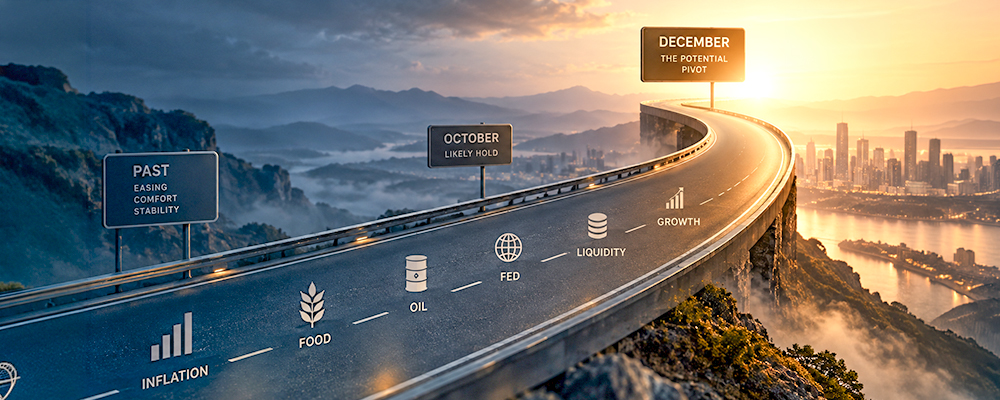
So, the question is no longer whether the RBI will move - it is when, how much, and how quickly. In this edition of the DMO, we examine whether the RBI's next move is likely to come sooner than markets expect. While we believe a rate hike at the 7 October 2026 policy appears unlikely on current evidence, the December meeting could emerge as the consequential inflection point. Should the inflation trajectory evolve in line with the RBI's projections, the Committee may be compelled to deliver not merely a symbolic 25 bps increase but potentially a larger 50 bps move, with cumulative tightening of up to 100 bps over FY2026-27 remaining a plausible outcome.
The Starting Point: What the RBI Actually Said on 5 August
POLICY REPO RATE | FY27 CPI FORECAST | FY27 GDP FORECAST | MPC VOTE |
Unchanged; SDF 5.00%, MSF 5.50% | Lowered from 5.1%; Q3 peak 5.9% | Raised from 6.6% | Poonam Gupta is notably hawkish |
Source: RBI Monetary Policy Committee Resolution and Monetary Policy Statement (August 2026); RBI MPC Minutes released 19 August 2026.
The August resolution kept the repo rate at 5.25%, retained the neutral stance, and cut the full-year CPI forecast to 5.0% from 5.1%. Growth for FY27 was nudged higher to 6.7% from 6.6%. Underneath the calm surface, however, the quarterly inflation path was quietly re-drawn: Q2 at 4.7%, a Q3 peak of 5.9%, and Q4 at 5.5% - a trajectory that spends three consecutive quarters above 5%1.
"Core excluding precious metals is expected to converge to core inflation in the last quarter |
The minutes went further. Poonam Gupta said in plain language that "scope for further easing does not exist" and that a case for a hike may emerge during the year. That is the single most important guidance the RBI has offered in this cycle. It tells the market the trigger for a hike is not just a headline print breaching a threshold - it is the persistence of underlying price pressure. This is hawkish forward guidance framed as caution.
The next MPC meeting is scheduled for 5-7 October 2026, followed by the December policy - the sixth and last of the calendar year under the FY2026-27 bi-monthly schedule.
1. Pillar One - Headline Inflation Is Already Doing the Committee's Work
August CPI | August FOOD CPI | RBI PROJECTION PEAK |
A 20-month high | Milk, vegetables and pulses contributed | Q3 FY27 peak |
Source: MoSPI Consumer Price Index Release for July 2026; RBI Monetary Policy Statement (August 2026). Data as of 17 September 2026.
Headline CPI rose further to 4.82% in August from 4.45% in July, marking a third consecutive month above the RBI's 4% target. Food inflation remains the key driver, with the Consumer Food Price Index (CFPI) accelerating to 5.95% from 5.52%, led by continued pressure in key food categories. The latest print reinforces the upward inflation trend and leaves the RBI with limited room to turn dovish in the near term2.
The RBI's own forecast - Q2 at 4.7%, Q3 at 5.9%, Q4 at 5.5% - implies that by the time the December MPC meets, the committee will have on its desk two more monthly prints on the way to a Q3 peak just 10 basis points below the upper tolerance band of 6%3. Historically, the MPC does not sit still when it is that close to the tolerance line.
The counter-argument, advanced by the RBI's own base case, is that the inflation broadening remains limited: core-core CPI is still near multi-year lows around 2%, generalization has not happened, and the impulse is largely supply-side. This is a reasonable read of the data today. It is harder to sustain if the December print validates the 5.9% projection.
2. Pillar Two - Food, Milk and the Second-Round Problem
MONSOON | COMPOSITION SHIFT | SECOND-ROUND RISK |
IMD forecast of a below-normal monsoon at ~92% of LPA and a mid-season deficit of ~13%4. | Food inflation shifting toward protein-rich items and processed foods. | Persistent protein and prepared-food inflation may transmit into core. |
Source: India Meteorological Department / Mausam seasonal monsoon outlook and rainfall updates; MoSPI CPI item-level inflation releases; RBI MPC Minutes (August 2026).
Overlay a below-normal monsoon - IMD has flagged rainfall at ~92% of LPA, with an El Nino risk - and the setup for the winter crop looks less than reassuring. Members of the MPC named food, fuel, El Nino risks to monsoon, and conflict-related supply shocks as sources of the projected inflation hump.
The counter-argument: food inflation is volatile and often reverses. A good northeast monsoon and a favourable base could pull food CPI back sharply by Q4. But hoping is not monetary policy, and the composition of India's food inflation - protein-rich items and prepared foods - is now stickier than in past cycles.
3. Pillar Three - The Commodity Upcycle Refuses to Subside
BRENT CRUDE | FY27 BASKET* | Q1 FY27 CAD | Q1 FY27 BOP |
Range-bound $91-100+ early Sept | Assumes de-escalation | 0.5% of GDP – widened | First deficit in 5 quarters |
Source: Bloomberg commodity and market data, RBI Balance of Payments / Current Account data release, MoSPI macroeconomic releases, IEA Oil Market Report (August 2026); Quantum internal estimates for FY27 oil-basket assumption. Data as of 31 August 2026.
Brent crude, having briefly softened around end-July on Iran talks, has firmed back to the $91-100+ range. On 21 August, Brent was at $93.82 on the second consecutive weekly rise; on 24 August, it eased to $93.17 ahead of the US sanctions announcement; oil rose again on 2 September on renewed US-Iran fighting5. The IEA Oil Market Report for August pen the Indian crude basket at about US$80 per barrel for FY27 - but that assumes a credible peace agreement between the US and Iran, an increasingly fragile assumption.
Q1 FY27 already registered a widening of the current account deficit to $4.2 billion (0.5% of GDP, versus $3.4 billion in Q1 FY26) and the balance of payments slipped into an $8.1 billion deficit on capital outflows - the first BoP deficit in five quarters6. If the commodity upcycle persists into H2 FY27, imported inflation will keep leaking into core over the next two to three quarters, exactly the convergence that Governor Malhotra warned about.
4. Pillar Four - The Fed Won't Let RBI Look Away
FED FUNDS RATE | September VOTE | FED Guidance | US 30Y YIELD |
First 25 bps hike since Dec 2025 | Unanimous Rate Hike Decision | Dot plot signals 1 more hike in Dec 26 | Long end remains elevated |
Source: U.S. Federal Reserve FOMC Statement (16 September 2026), , CME FedWatch Tool (August 2026), Federal Reserve Bank of St. Louis / FRED yield data, Bloomberg market data.
The Fed delivered a 25bp hike in September, raising the Fed funds rate to 3.75-4.00% in a unanimous 12-0 vote after holding rates unchanged since December 2025. Updated projections point to at least one additional hike this year, reinforcing a hawkish policy stance7.
For India, higher US rates further narrow the carry advantage as the 10-year G-sec remains around 6.9-7.0%. With FII flows already under pressure in 2026, a sustained Fed tightening cycle increases the burden on the RBI to defend rate differentials rather than rely solely on currency adjustment.
Why this matters for RBI is not just symmetry - it is arithmetic. The India-US 10-year spread has compressed to a historic ~210-230 bps9. If RBI wants to bridge the carry gap rather than let the rupee do the adjustment, the response has to be visible. A token 25 bps hike may buy little. |
5. Pillar Five - Geopolitics Is a Structural, Not a Cyclical, Variable Now
The US-Iran conflict, which broke out in earnest in March 2026 and saw a fragile June truce, remains open. The 18 August ceasefire ended within hours; fresh attacks were reported through August; markets have opened the first week of September lower on renewed Mideast escalation. TheSeptember session marginally lower on higher oil and Iran tension.
Geopolitics affects Indian monetary policy through three channels: (a) oil-price pass-through into CPI and CAD (b) LNG and shipping costs into producer margins and eventually core CPI and (c) risk aversion in EM portfolio flows.
All three currently point the same way - toward tighter, and not a loose policy.
6. Pillar Six - Growth Is Not the Constraint This Cycle
Q1 FY27 GDP | MANUFACTURING | INVESTMENT (GFCF) | UNDERLYING DEMAND |
Beat RBI forecast of 7.0% | Robust despite disruptionsn | Strongest engine | Adjusted for deflator |
Source: MoSPI Q1 FY27 National Accounts Release; RBI Monetary Policy Statement (August 2026); Bloomberg consensus / market expectation data; Quantum internal estimates for underlying demand adjusted for deflator effects.
India’s growth backdrop arguably provides the strongest justification for the RBI to consider a tightening cycle if inflation risks continue to build. Real GDP growth of 7.8% in Q1 FY27 not only exceeded the RBI’s own estimate of 7.0% but also came in meaningfully ahead of market expectations of around 7.1%.8 More importantly, the composition of growth was encouraging. Manufacturing expanded by 9.2%, signaling that the industrial recovery remains intact despite global uncertainties, while gross fixed capital formation surged 11.9%, highlighting continued strength in private and public investment activity. Even after adjusting for the unusually favorable GDP deflator and stripping out some of the statistical tailwinds, estimates suggest that underlying demand-led growth is still running at roughly 6.5%8. That may be lower than the headline figure, but it remains comfortably above India’s estimated potential growth rate and points to an economy that is operating with considerable resilience.
From a policymaker’s perspective, this matters because it changes the risk-reward tradeoff. When growth is fragile, central banks tend to tolerate temporary inflation shocks in order to protect economic momentum. Today, however, the Indian economy appears sufficiently robust to absorb a moderate increase in borrowing costs without materially jeopardizing the growth outlook. Consumption remains healthy, investment activity continues to accelerate, credit growth remains supportive, and corporate balance sheets are considerably stronger than they were in previous tightening cycles. In such an environment, the RBI has both the analytical justification and the political space to prioritize inflation risks if it believes price pressures are becoming more persistent.
That said, the growth argument is not entirely one-sided. The key question for the MPC is not where growth stands today, but where it is likely to be six to nine months from now. Monetary policy works with long and variable lags, and the full impact of a rate hike typically takes two to three quarters to filter through the economy. While Q1FY 27 growth was undeniably strong, there are legitimate questions around the sustainability of that momentum through the second half of FY27. A slower global economy, tighter global financial conditions, weaker fiscal spending momentum, and the possibility of softer consumption after the festive season could all weigh on activity as the year progresses. In that context, an immediate rate hike in October could be viewed as unnecessarily pre-emptive, particularly when the inflation surge is still largely driven by food and commodity-related factors.
This is precisely why the timing debate becomes crucial. The growth data do not argue against a rate hike; if anything, they strengthen the case that the economy can withstand one. However, they do support the argument for waiting until more information becomes available. By the December policy meeting, the RBI will have the benefit of several additional inflation readings, a clearer picture of festive demand, updated growth indicators, and better visibility on global developments, including the trajectory of U.S. monetary policy. In other words, the strength of growth today provides the RBI with the flexibility to hike if needed, but it does not necessarily compel the RBI to act immediately in October. That distinction is why a hawkish hold in October followed by a decisive move in December remains, in our view, a plausible policy path.
7. Pillar Seven - The Liquidity Deluge Nobody Expected
BANKING SURPLUS | FCNR(B) INFLOWS | Sept 15 VRRR | ABSORBED Sept 15 |
As on 11 September 26 | Jun-Aug, 31 2026 | via longer tenor VRRRs with maturities ranging from 15 days to 30 days | vs Rs 5 L Cr notified |
Source: RBI liquidity operations and money-market data releases; RBI FCNR(B) swap-window / external-sector policy communications; RBI daily liquidity management and VRRR auction notifications. Data as of September 15,2026.
This is where the debate becomes interesting. If inflation is a visible risk confronting the RBI, liquidity may be an underestimated one. The June 2026 policy package was designed to attract foreign currency inflows through a combination of FCNR(B) swap facilities, ECB-related incentives, and regulatory relaxations. The objective was clear: strengthen external buffers and support capital inflows during a period of heightened global uncertainty. What the RBI perhaps did not anticipate was the sheer scale of the response.
The FCNR(B) swap window, originally scheduled to remain open until the end of September, was closed a month ahead of schedule after attracting $52.3 billion of inflows by the end of August9. While Governor Sanjay Malhotra described the early closure as a calibration exercise, the success of the scheme has created an entirely different policy challenge. Banking-system liquidity surplus surged to ₹6.65 lakh crore by 31 August9, the highest level in years, forcing the RBI to conduct simultaneous liquidity absorption operations through ₹10 lakh crore of VRRR auctions**9. (**currently ongoing)
The significance of this excess liquidity goes beyond money-market technicalities. With the weighted average call rate (WACR) consistently trading below the repo rate, the effective monetary stance is arguably more accommodative than the headline policy rate of 5.25% suggests. In other words, despite the RBI's neutral stance, financial conditions remain exceptionally easy.
This becomes particularly relevant if inflation follows the path that the RBI itself has projected. A temporary rise in food and commodity prices can often be ignored by central banks, but abundant liquidity creates the risk that what begins as a supply-side inflation shock eventually spills over into broader demand conditions. Strong credit growth, easy financial conditions and surplus liquidity can amplify pricing power across sectors, making inflation more persistent than initially expected.
This is why liquidity may ultimately become a key factor in the rate debate. If inflation rises toward the projected 5.9% peak in Q3 FY2710 while liquidity remains in substantial surplus, the RBI may find that liquidity absorption alone is insufficient. In that scenario, a rate hike would no longer be merely a signaling tool - it would become a necessary policy response to ensure that excessively loose financial conditions do not reinforce emerging inflationary pressures.
The Dovish Rebuttal - Why the RBI May Actually Not Hike
To be fair, the counter-case deserves a fair hearing. There are three strong dovish arguments:
1. CORE IS STILL CONTAINED | 2. SUPPLY SHOCKS | 3. ALTERNATIVES EXIST |
Core-core CPI is near historical lows around 2%. Market participants believe the RBI shall stay on hold through 2026 on this basis. | Flexible inflation targeting permits looking through supply-side spikes. Food inflation and oil may reverse. | The RBI has forex intervention, OMO sales, VRRR and CRR to manage liquidity and the rupee without touching repo. |
There is also a political-economy argument: the RBI cut 100 bps in the last easing cycle to bring the repo rate to 5.25%. Reversing course inside a year could be reputationally costly. Governor Malhotra's repeated preference for waiting for more certainty is consistent with an MPC that would rather over-communicate than pre-empt.
The dovish scenario is: October pause, December pause with hawkish forward guidance, and no hike unless Q3 actual CPI meaningfully breaches the 5.9% projection. We assign this scenario a probability of around 30-35%. (Not negligible - but not the base case).
Why is October unlikely to see the first hike? The July CPI print of 4.45% is comfortably below the 6% upper band. There is no monthly data point between now and 7 October that would force the RBI's hand - the September CPI comes only in mid-October, after the meeting. A first-of-cycle hike delivered pre-emptively would look reactive.
Why is December the natural pivot? By early December the MPC will have visibility on September, October, and November CPI prints - three data points that will either validate the 5.9% Q3 projection or refute it. It will also have post-FOMC Fed guidance. The information advantage is decisively higher in December.
Why the first hike could be 50 bps rather than 25 bps:
The carry-preservation argument: With the India-US 10Y spread at ~210 bps and a possible Fed hike, a 25 bps hike may be inadequate for durable rupee stabilisation.
The liquidity-offset argument. With Rs 6.65 lakh crore of surplus liquidity, a 25 bps repo hike may not move the WACR meaningfully; a 50 bps hike with absorption may change the money-market complexion visibly.
The signalling argument. After 100 bps of cuts, a return to hikes needs to send an unambiguous message. Better one 50 bps move than three catch-up 25 bps moves.
If December delivers 50 bps, a follow-up 50 bps in February 2027 would take the terminal FY27 repo rate to 6.25% - exactly a 100 bps cumulative tightening in the fiscal year.
A Reasoned Base Case
BASE CASE (~65%) | AGGRESSIVE CASE (~15%) | DOVISH CASE (~10%) |
Hold in October; 50 bps hike in December; 25 bps hike in February 2027. Cumulative FY27 tightening: 75 bps. | 50 bps in December and 50 bps in February. Cumulative tightening: 100 bps. | No hikes in FY27. Food reverses, oil de-escalates, Fed does not hike, and core stays contained. |
The single most important disagreement between the base and aggressive cases is the composition of the December move. Both agree an October hike is unlikely. Both agree that if RBI moves in December, it will be a genuine cycle re-entry, not a symbolic gesture.
Where the aggressive case can prove right: if RBI is late and Q3 CPI delivers on the 5.9% projection, then December 50 bps plus February 50 bps becomes not just plausible but arguably necessary. Market pricing today does not reflect this outcome; positioning is asymmetric.
Where the aggressive case can prove wrong: if the northeast monsoon repairs the food outlook, crude de-escalates on peace, the Fed pauses through November, and core inflation stays near 2% core-core. Any two together would materially reduce hike probability.
What This Means for Markets
10Y G-SEC | 1Y OIS 6.10% - To Rise | 5Y OIS | RATE-SENSITIVES |
to 7.25% if priced | Curve to bear-steepen | Curve to bear-steepen | Home/auto/MSME to firm |
Source: Bloomberg fixed income and OIS market data; RBI monetary policy and liquidity communications; market yield data as of September 15, 2026.
For fixed income investors, the implications are becoming increasingly asymmetric. Markets have already started to acknowledge the possibility of a policy shift later this year, which means a continued pause in October is unlikely to trigger a meaningful rally in bonds. In contrast, any indication that the RBI is preparing to tighten policy (particularly if accompanied by firmer inflation data) could result in a much sharper repricing of yields. In other words, the upside from being positioned for a prolonged pause appears limited, while the downside from underestimating a hawkish turn is becoming significant. Against this backdrop, maintaining a neutral-to-underweight duration stance, with a preference for shorter maturities and carry paper exposure, appears prudent until there is greater clarity on the inflation trajectory and the RBI's reaction function.
The outlook for the rupee and carry trades is equally nuanced. Much will depend on whether the RBI chooses to preserve India's relative yield attractiveness through an actual increase in policy rates or by relying on liquidity-management and sterilization tools. Governor Sanjay Malhotra has consistently emphasized a preference for using a broad toolkit and conducting two-way liquidity operations before resorting to policy rate changes. However, those tools are not limitless. With India-US yield differentials having compressed significantly and global investors becoming increasingly sensitive to relative carry opportunities, the RBI may eventually find that liquidity management alone is insufficient. If preserving external competitiveness and attracting foreign capital becomes a policy priority, the case for a direct rate response strengthens considerably.
Takeaways
The RBI’s views in August 2026 is no longer the same as it was for the RBI that cut 100 bps in FY26. It is now a committee that has already said out loud that scope for further easing does not exist, that a case for a hike may emerge during the year, and that convergence of core measures may itself justify a recalibration. That is a committee preparing markets for a move, not a committee that intends to sit still.
On balance, we believe:
October 7, 2026 policy will be a hawkish hold - no rate change, but a hint towards a stance shift or unusually direct forward guidance is plausible. Probably some dissent in the votes as well within the MPC members.
December is the likely pivot - probability of a hike is ~65-70%, materially higher than what the OIS curve currently prices.
The size of the December move, if it happens, could be 50 bps rather than 25 bps - driven by surplus liquidity, narrowing India-US carry, and second-round effects.
Cumulative FY27 tightening of at least 100 bps - December 50 bps plus February 50 bps - has a probability of around 15-20%. It is not the base case, but meaningful enough that portfolios should not be structured as if it were impossible.
What does this mean for investors?
If the central question is no longer whether rates move, but when and by how much, then fixed income investors face an environment where both inflation and policy uncertainty are rising simultaneously. In such periods, attempting to maintain a single duration view can become an additional source of risk.
Dynamic bond funds offer a different proposition. Rather than forcing investors to make a binary call on the rate cycle, they allow duration, yield curve positioning and cash levels to evolve with incoming data. Whether the RBI ultimately delivers a hawkish hold, a 25 bps hike or an aggressive tightening path, the emphasis shifts from anticipating outcomes to adapting to them.
When the range of possible policy outcomes widens, flexibility itself becomes a source of risk management.
Sources used across the note: 1/3/6/8/9/10:: RBI Monetary Policy Statement, MPC Resolution, MPC Minutes, liquidity operations, BoP and external-sector releases; 2: MoSPI CPI and National Accounts releases; 4:India Meteorological Department / Mausam monsoon updates; 5/7: Bloomberg market and commodity data; IEA Oil Market Report; U.S. Federal Reserve FOMC Statement and Minutes; CME Fed Watch Tool; Federal Reserve Bank of St. Louis / FRED; NSDL FPI flow data; Quantum internal estimates .For any queries directly linked to the insights and data shared in the newsletter, please reach out to the author - Sneha Pandey, Fund Manager - Fixed Income at [email protected].
For all other queries, please contact Manish Sharma - Head - Sales, Quantum AMC at [email protected] / [email protected] or call him on Tel: +919742000580
Read our last few Debt Market Observer write-ups -
- Are Indian G-Secs Mispriced Amid Sticky Global Yields?
- FCNR 2.0: Same Instrument, Different India Why 2026 Is Not 2013
Disclaimer, Statutory Details & Risk Factors:The views expressed here in this article / video are for general information and reading purpose only and do not constitute any guidelines and recommendations on any course of action to be followed by the reader. Quantum AMC / Quantum Mutual Fund is not guaranteeing / offering / communicating any indicative yield on investments made in the scheme(s). The views are not meant to serve as a professional guide / investment advice / intended to be an offer or solicitation for the purchase or sale of any financial product or instrument or mutual fund units for the reader. The article has been prepared on the basis of publicly available information, internally developed data and other sources believed to be reliable. Whilst no action has been solicited based upon the information provided herein, due care has been taken to ensure that the facts are accurate and views given are fair and reasonable as on date. Readers of this article should rely on information/data arising out of their own investigations and advised to seek independent professional advice and arrive at an informed decision before making any investments. Mutual Fund investments are subject to market risks, read all scheme related documents carefully. |

View All
Related Posts
-

The Case for the December Pivot
Posted On Monday, Sep 21, 2026
For the last twelve months, Indian fixed income has been a story of comfortable pauses, benign carry, and a gently steepening curve.
Read More -

What Does the West Asia Crisis Mean for India’s Economy?
Posted On Tuesday, Mar 24, 2026
Over the past few years, geopolitics has steadily returned to the center of global economic discussions.
Read More -

Looking Beyond the 10-Year Benchmark: Decoding India’s Bond Market Signals
Posted On Thursday, Feb 26, 2026
If you glance at India’s financial headlines today, the tone feels reassuring.
Read More