
Debt Outlook - August 2026
Posted On Monday, Aug 03, 2026

From Rising Oil Prices to RBI Pause: The August Outlook for Indian Bonds
Indian fixed income enters August after its sharpest single-week scare of an already volatile quarter. Renewed escalation in West Asia drove Brent crude to $100 a barrel for the first time since May 221, pushing the 10-year G-Sec to 6.85%, its highest level since June 231. A weekend de-escalation has since reversed much of the move, with both oil and yields retreating and the bond market opening firmer this week.
But the round trip itself is the story. India's bond market is now trading largely off the oscillation between Gulf escalation and de-escalation, demonstrating twice in recent months that yields can move 10-15 basis points in either direction within days on that variable alone.
Chart I: 10-Year G-Sec touched 6.85%; Highest since June 23 before easing on West Asia de-escalation
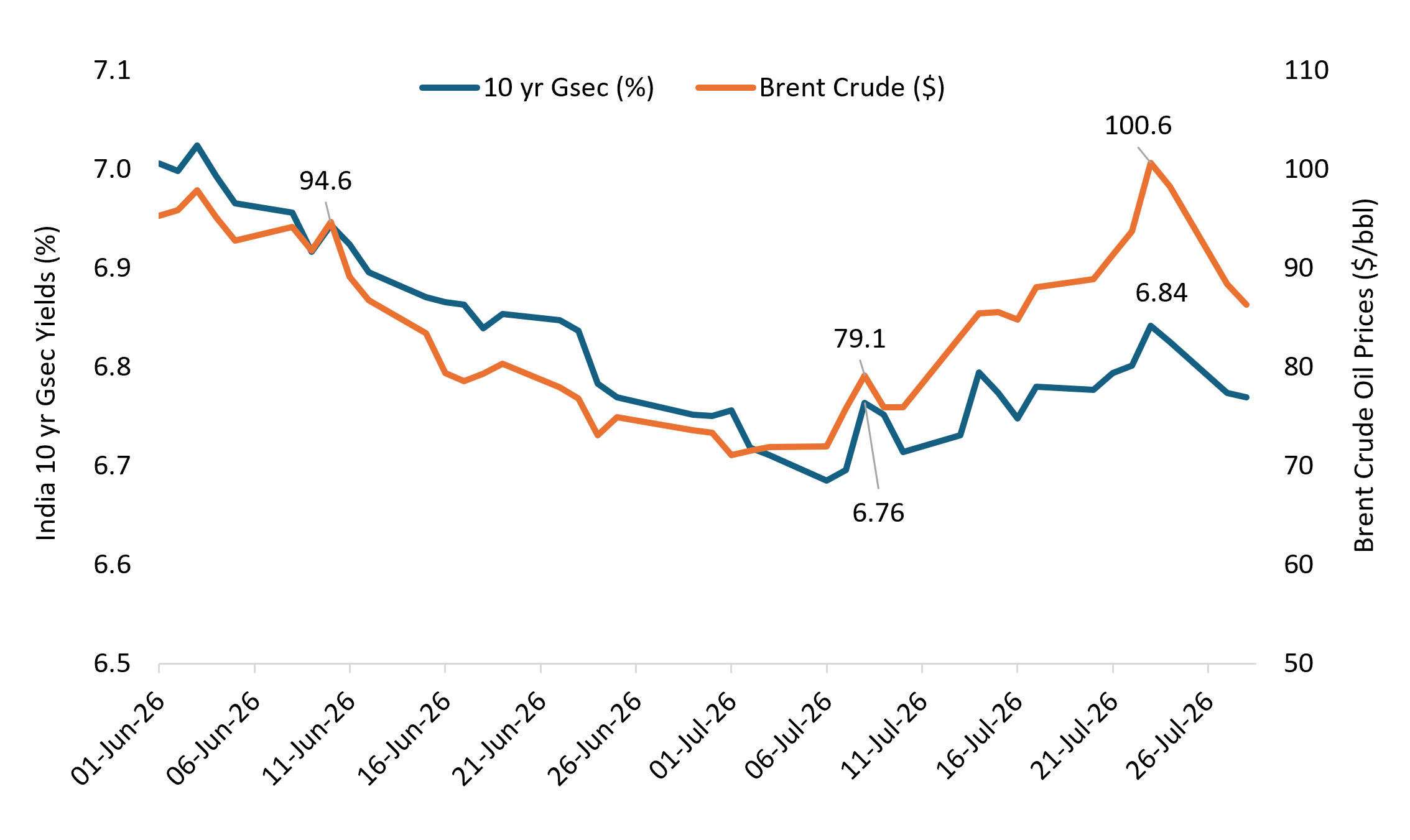
Data Source: Quantum AMC Graphics. Data Source: NSE Cogencis, CCIL. Data up to July 28, 2026
The question for August is not whether the RBI stays put on its pause in policy rates. It almost certainly will. The question is whether markets get a sustained period of de-escalation long enough to test the lower end of the yield range, or whether another flare-up arrives first.
RBI and the Fed: Two Central Banks, Both Expected to Hold
Our base case remains unchanged: the RBI stays on an extended pause, viewing the June CPI print of 4.38% primarily as a supply-side development rather than evidence of demand pressures. Core inflation, excluding gold, silver, fuel and food, remains near multi-year lows.
The more immediate catalyst lies offshore. While markets broadly expected the FOMC to keep rates unchanged at its July 2026 meeting, investor focus was centered on the policy guidance and tone of communication rather than the rate decision itself. However, expectations for a September rate cut have moderated, with markets adopting a more hawkish stance amid the Fed Chair's less accommodative messaging and limited forward guidance on the easing path.
Energy prices have moved sharply ahead of the meeting, and a hawkish Fed layered onto an oil-driven rise in yields would be an adverse combination for EM duration.
G-Sec Supply: Strong Long-End Demand Despite Higher Borrowing Costs
The primary market delivered a nuanced message. The Centre's G-Sec auction saw the weighted average borrowing cost rise sharply to 7.28%3, but this reflected tenor composition more than weak demand. The 50-year tranche attracted strong interest from insurers, provident funds and pension managers, with the cut-off price comfortably above expectations, evidence of continued structural demand for long-duration assets. The 15-year segment was largely in line with estimates, while the overall bid-to-cover ratio of 2.83 matched its long-term average.
Secondary market demand remains anchored by public sector banks and institutional investors, while primary dealers were the largest net sellers and foreign banks turned net sellers for the first time in over two months4, a development worth monitoring despite continued positive FPI flows into FAR securities.
Meanwhile, T-bills remain the weakest segment of the curve, with cut-off yields rising for a fourth consecutive auction across all maturities. The move reflects an ongoing funding gap, with credit growth of 17.7% YoY continuing to outpace deposit growth of 13.3% YoY, keeping the credit-deposit ratio elevated at 82.7% and sustaining pressure on short-term funding costs5.
Currency: A Stronger Backstop Than Before
The most encouraging development comes from the RBI's increased transparency on external funding support. The Governor recently disclosed that FCNR(B) and ECB measures have generated USD 32 billion of inflows so far (largely via FCNR(B)6, converting what was previously viewed as a supportive policy initiative into a measurable source of balance-of-payments support.
Combined with USD 2.1 billion of net FPI inflows last week, USD 4.4 billion month-to-date and active RBI intervention7, these flows helped contain rupee weakness even during the $100-oil spike phase. USD/INR is now trading below 96, reflecting the easing in geopolitical tensions.
June REER data continues to suggest the rupee remains undervalued in real terms, providing an additional buffer. FX reserves to USD 676.2 billion, although they remain lower through FYTD27, underscoring the cost of intervention8.
The Month Ahead: Rangebound
Our core view for August remains largely unchanged, though the factors worth monitoring have broadened. The market is no longer solely about oil and Gulf headlines; liquidity conditions now merit equal attention.
We expect the 10-year yield to remain broadly within the 6.70%-6.85% range9, testing the lower end if de-escalation proves durable and the Fed delivers a benign message, while renewed geopolitical stress could quickly push yields back toward the upper bound.
In an environment this two-sided, flexibility remains more valuable than conviction. Oil, Fed and RBI expectations and domestic liquidity have all reversed direction multiple times in recent weeks. Dynamic Term Funds, with the flexibility to adjust duration as conditions evolve, remain structurally better suited than fixed-duration strategies.
With such a volatile and rangebound backdrop, investors generally tend to resort to generating additional yield by accepting weaker credit quality. When meaningful two-way volatility already exists in rates and liquidity, adding credit risk is not diversification; it is simply introducing another uncompensated source of uncertainty. Our preference remains to actively manage duration while keeping credit quality concentrated in Government Securities and AAA-rated PSU bonds. Strong demand for longer dated maturities reinforces that long-horizon institutional investors are not pricing panic into the long end, despite continued pressures in short-term funding markets. That divergence is the kind of nuance a dynamic, quality-anchored approach is designed to navigate in our Quantum Dynamic Term Fund.
Source: 1/3/9Bloomberg; 2The Federal Reserve; 3/4Clearance Corporation Of India Limited; 5/6/7/8Reserve Bank of India
 |
Disclaimer, Statutory Details & Risk Factors:The views expressed here in this article are for general information and reading purpose only and do not constitute any guidelines and recommendations on any course of action to be followed by the reader. Quantum AMC / Quantum Mutual Fund is not guaranteeing / offering / communicating any indicative yield on investments made in the scheme(s). The views are not meant to serve as a professional guide / investment advice / intended to be an offer or solicitation for the purchase or sale of any financial product or instrument or mutual fund units for the reader. The article has been prepared on the basis of publicly available information, internally developed data and other sources believed to be reliable. Whilst no action has been solicited based upon the information provided herein, due care has been taken to ensure that the facts are accurate, and views given are fair and reasonable as on date. Readers of this article should rely on information/data arising out of their own investigations and advised to seek independent professional advice and arrive at an informed decision before making any investments. Mutual Fund investments are subject to market risks, read all scheme related documents carefully. |

View All
Related Posts
-
Debt Outlook - October 2026
Posted On Thursday, Oct 01, 2026
The debt market enters October with a more challenging backdrop than it did a few months ago. Global bond yields have moved higher
Read More -

Debt Outlook - September 2026
Posted On Thursday, Sep 03, 2026
Indian fixed income enters September with a broadly supportive domestic foundation, but with less room for a one-way duration view.
Read More -

Debt Outlook - August 2026
Posted On Monday, Aug 03, 2026
Indian fixed income enters August after its sharpest single-week scare of an already volatile quarter.
Read More